

The heart counts not in hours or years but in pulses: systole, diastole - a binary rhythm older than language. To be alive is to be governed by this pulse. A biological tempo, internal and inescapable. Each contraction is both an affirmation of survival and a restriction of duration. Unlike clocks, which measure time as a concept, the heart marks time as a condition, structuring experience into an embodied chronology. The first sound we hear in the womb is not the voice of the mother but her heartbeat, a liquid metronome that teaches us time before we are even born.
The word ‘heart’ is among the oldest in the English language, a linguistic fossil rooted in the bedrock of our speech. It’s older than the language of empire, older than the machines that now monitor its rhythm, older even than the anatomical certainty of its own function. In the roots of heorte from Old English, one can trace Indo-European ancestry - kerd, k̂erd, the same syllable that gave rise to the Latin cor, the Greek kardia, and thus cardiac, core, courage. To possess courage, originally, was not to be fearless but to speak with one’s full or open heart. Le cœur ouvert. A gesture not of bravery, but of exposure: a heart unshielded, language unarmoured. This linguistic scaffolding reveals a cultural logic that the heart is not merely a muscular pump, but a seat of expression, of ethical and emotional truth laid bare. The lexicon thickens: cordial, discord, record - to record, literally, to call back to the heart. The mind may forget, but the heart retains.
Linguistically, the heart is paradoxical: it’s where we locate both strength and fragility. “Heartless” describes cruelty, but “soft-hearted” describes kindness. “Open-hearted” suggests welcome, “faint-hearted,” cowardice. It’s a container that holds contradiction. A word that cannot be made to mean only one thing. The heart was named not for its function, but for what it seemed to contain - sorrow, loyalty, conviction, rage. To speak of the heart was to speak of the self in its most undressed state. Where the mind is associated with clarity, distance, reason, the heart is linked to density - to what cannot be unwound. It’s not the seat of logic, but of meaning. This linguistic division persists, even now: we don’t say we are ‘mindbroken’ when we suffer nor do we call someone ‘big-minded’, even if their generosity is intellectual. The heart offers a vocabulary where language falters - a way to speak about what is felt but not yet named. When we say, “I know it in my heart,” we don’t mean evidence. We mean something more innate, less translatable. A knowing that precedes articulation. More, to memorise something “by heart” is to absorb it so completely that it cannot be forgotten. The phrase predates cardiology. It speaks to an understanding that does not reside in the frontal lobe but in the body itself. Recitation, song, rhythm - all of these are ways the body remembers.
Art has always sought to reveal what flesh conceals. The earliest representations of the heart were not anatomical but symbolic. In Catholic art, the Sacred Heart of Jesus pulses outside the body - crowned with thorns, burning, radiant. It’s not portrayed as a muscle, but a theological wound - a source of both love and suffering. In medieval iconography, the heart was sometimes held in the hand, a metaphor made literal. Saints presented their hearts to God, bleeding but intact - a gesture of absolute surrender. These images taught that to feel deeply was to be sanctified but also endangered. That the heart, once offered, could not be reclaimed without consequence.

Pompeo Batoni, The Sacred Heart of Jesus, 1767
Renaissance anatomists, by contrast, opened the chest with scalpel and charcoal. Leonardo da Vinci sketched the heart with obsessive precision: valves, chambers, spirals of muscle. Yet even in this clinical gaze, reverence lingers. Da Vinci’s heart is not just a pump; it is an architecture, a cathedral of blood.
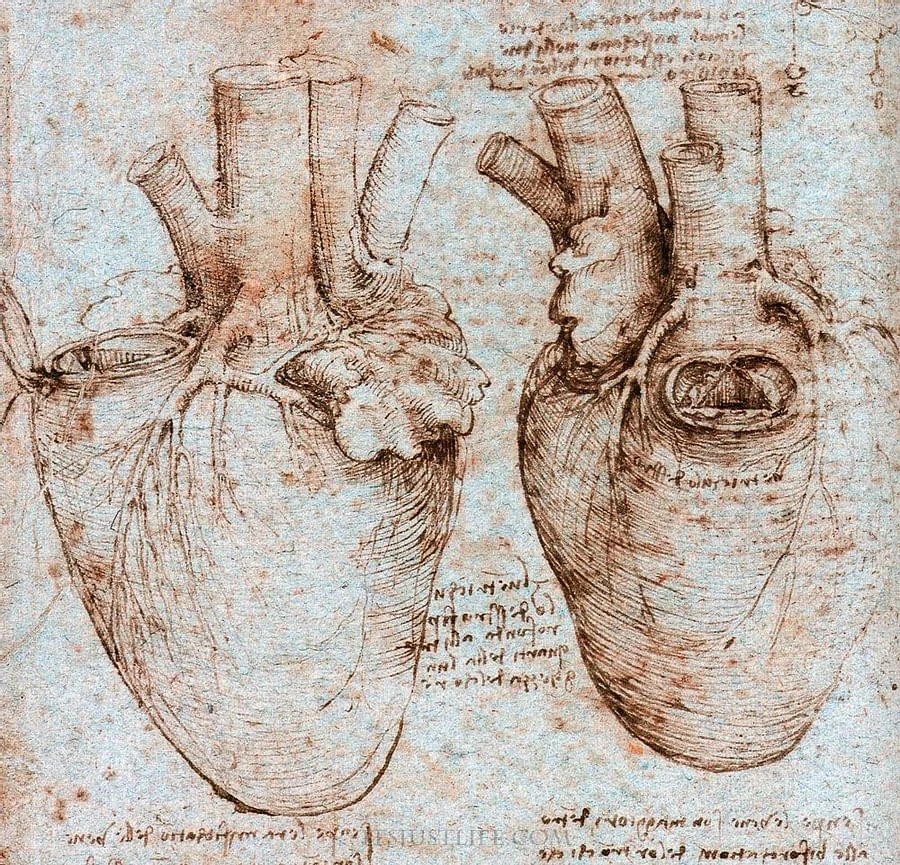 Leonardo da Vinci, 1513
In Jean-Michel Basquiat’s work, the heart appears alongside crowns, bones, scribbled names - a symbol of raw existence. For Frida Kahlo, the heart is torn from the chest, tethered by veins, exposed and bleeding. In The Two Fridas, one holds surgical scissors, the other clasps a miniature portrait. Between them, a vein links their hearts. It is an image not of sentiment, but of psychic rupture.

Frida Kahlo, the Two Fridas, 1939
Across thought and poetics, the heart is a staple of risk in place of stability. It’s most often employed to detail what can’t be hidden, where the self is least defended and the identity most porous. Rilke writes of it as an impossible vessel: “Oh, not because happiness exists, that too-hasty profit snatched from approaching loss, / not out of curiosity… but because being here is so much.” In his lines, the heart is where being exceeds itself and presence overwhelms containment. Emily Dickinson's poetic corpus too, reveals a preoccupation with the heart's inability to remain hidden. When she writes "The Heart asks Pleasure first", followed by increasingly desperate requests culminating in "The privilege to die," she acknowledges the heart's progression from desire to ultimate vulnerability.
On Thursday 14th September 2023, I had a heart attack. The medical record would later describe it as a "coronary vasospasm causing a NSTEMI," but such clinical language fails to capture the ordinary strangeness of the moment.

The term “heart attack” is a metaphor barely disguised as terminology; a term believing of itself to be literal. The phrase doesn’t name an affliction so much as stages a confrontation. It casts the heart as both target and traitor, a locus of betrayal that is somehow both intimate and impersonal. It’s not just that one’s heart is in crisis, but that it has turned hostile. “Attack” presupposes opposition, categorising the body not as a unified whole but as a terrain divided - one part assailing another. It demands an enemy but provides none; a war waged without a witness where the borders of attacker and attacked dissolve. To this end, for the heart to launch an attack on the body is to destabilise its own logic. It’s not just the body that’s breached, but the very grammar of aliveness too. The medical nomenclature attempts precision through categorisation: myocardial infarction, coronary thrombosis, cardiac arrest. Each term seeks to contain through specificity what is essentially uncontainable - the moment when mortality announces itself through the very organ tasked with sustaining life.
These clinical designations belong to the vocabulary of medicine, but they simultaneously inhabit the structures of allegory.
The medicalisation of the heart imposes its own metaphors. The heart becomes mechanical: it "functions" rather than feels, it "performs" rather than pulses. The cardiologist speaks of "efficiency" and "output," – a vocabulary borrowed from engineering that threatens to reduce the heart to its utilitarian purpose. Yet even in this clinical context, older metaphors persist. The physician who told me “Your heart is strong but stressed", was engaging not just in diagnosis but in characterisation – attributing to the organ qualities of personality and resilience.
At 21, I possessed what the medical establishment considers a "young heart" - an organ presumed reliable and unquestioned. My heart had transgressed a cultural boundary, however; In that moment, both impossibly young and prematurely aged - a contradiction embodied. To be young with a heart condition is to experience a particular form of embodied dissonance. The cultural script of youth presumes cardiovascular invincibility – the heart as boundless resource, capable of surges of exertion, emotional intensity, and recovery. When this narrative is interrupted, one must author a new relationship to one's body. The healthy young heart is prodigal, wasteful, generous. The compromised young heart must become careful, attentive, economical.
Sontag writes that upon entering the kingdom of the sick, one takes on "a dual citizenship." The young cardiac patient, however, acquires something more complex: simultaneous membership in seemingly incompatible categories, their very presence testifying to statistical improbability. The change does not occur all at once, nor does it follow the structure of revelation. The privilege of health - one that has been passive in its omnipresence, rarely noticed until it’s no longer assured - wanes much like a flower out of season. The heart and I from this day on no longer shared a mutual relationship of confidence. I did not mistrust it entirely, but I no longer believed it was bound to me in the same way as it once was. The body, once an extension of will, had revealed itself as other: opaque, unpredictable, capable of revolt.
What artists, poets and philosophers have sought for centuries through metaphor and symbolism – to expose the heart, to make visible what is hidden – the heart attack accomplishes in a single, brutal gesture. It is the heart's most radical act of self-disclosure; the moment when the organ abandons its defining discretion and announces itself not through steady rhythm but crisis. The attack marks exposure in its most literal sense – the interior made unavoidably present. The heart, which had maintained its privacy through regular function, now makes itself known through dysfunction. This is not revelation as epiphany but revelation as emergency – the sudden dropping of a veil that was never meant to be lifted. When the heart exposes itself through crisis, it simultaneously withdraws what it had always silently promised: continuity, reliability, the unconscious affirmation of survival that each beat previously guaranteed. The heart attack transforms each heartbeat from confirmation into question. The organ that once testified to life's persistence through its steady rhythm now testifies to life's contingency through its faltering. The pulse that once marked time now marks uncertainty.
In art, the exposed heart appears as deliberate revelation – the Sacred Heart of Jesus radiating divine love, the anatomical drawings of da Vinci unveiling hidden architecture, Frida Kahlo's painted hearts externalising internal pain. These exposures serve meaning, expression, connection. The heart attack, by contrast, is exposure without intention, significance without purpose – a breach in the body's narrative continuity that serves no artistic or philosophical end except to announce mortality itself. The exposed heart in artistic tradition invites witness; it asks to be seen, interpreted, understood. The cardiac event demands witness; it permits no turning away, no metaphorical reading, no aesthetic distance. It drags awareness to the precise location of the body's most essential vulnerability. What art attempts through representation, the heart attack accomplishes through direct sensation – the undeniable presence of the organ that both sustains and endangers life.
After exposure, there is no return to concealment. The heart, once it has announced its vulnerability, cannot retreat back into silence. Like a confession that cannot be unspoken or a secret that cannot be reclaimed, the heart's self-disclosure permanently alters the relationship between organ and awareness. After trauma, the heart bears witness to its history. Dead cells in the heart are replaced not with functional tissue but with fibrous material that cannot contract. The scarred heart is permanently altered, its rhythm and efficiency changed.
Yet it continues. It adapts. It finds new pathways for blood, new patterns of contraction. The metaphor extends beyond the physical: psychological adaptation follows similar principles. We do not return to who we were before cardiac injury. We become someone new, shaped by both damage and recovery.
I’m writing this 19 months and one week since my heart attack. The language of recovery implies return, but there is no return - only the quiet recalibration of presence. I live with the knowledge that my heart is no longer anonymous. It declares itself in small, persistent ways and I listen to it not as a poet listens for metaphor, but as a translator listens for inflection, trying to discern signal from noise. To have suffered an attack on the heart is to suffer an attack on the implicit contract of survival that the heart, in its constancy, once appeared to guarantee. What remains now is a watchfulness, a reverent suspicion. I live not in spite of this knowledge, but with it - an ongoing accommodation of uncertainty in a body that continues, quietly, to beat.

Eli Tomlin-Kent has just finished his second year at the University of Liverpool. Eli has been writing since he can remember and seem to gravitate towards prose poetry, life writing and the occasional prose piece.
More work by Eli Tomlin-Kent




Tel: 028 7126 6946
Email: hueditor@theverbal.co
Verbal, Stable Lane and Mall Wall, Bishop Street Within, Derry/Londonderry, BT48 6PU
 company
Copyright © 2026 Honest Ulsterman