


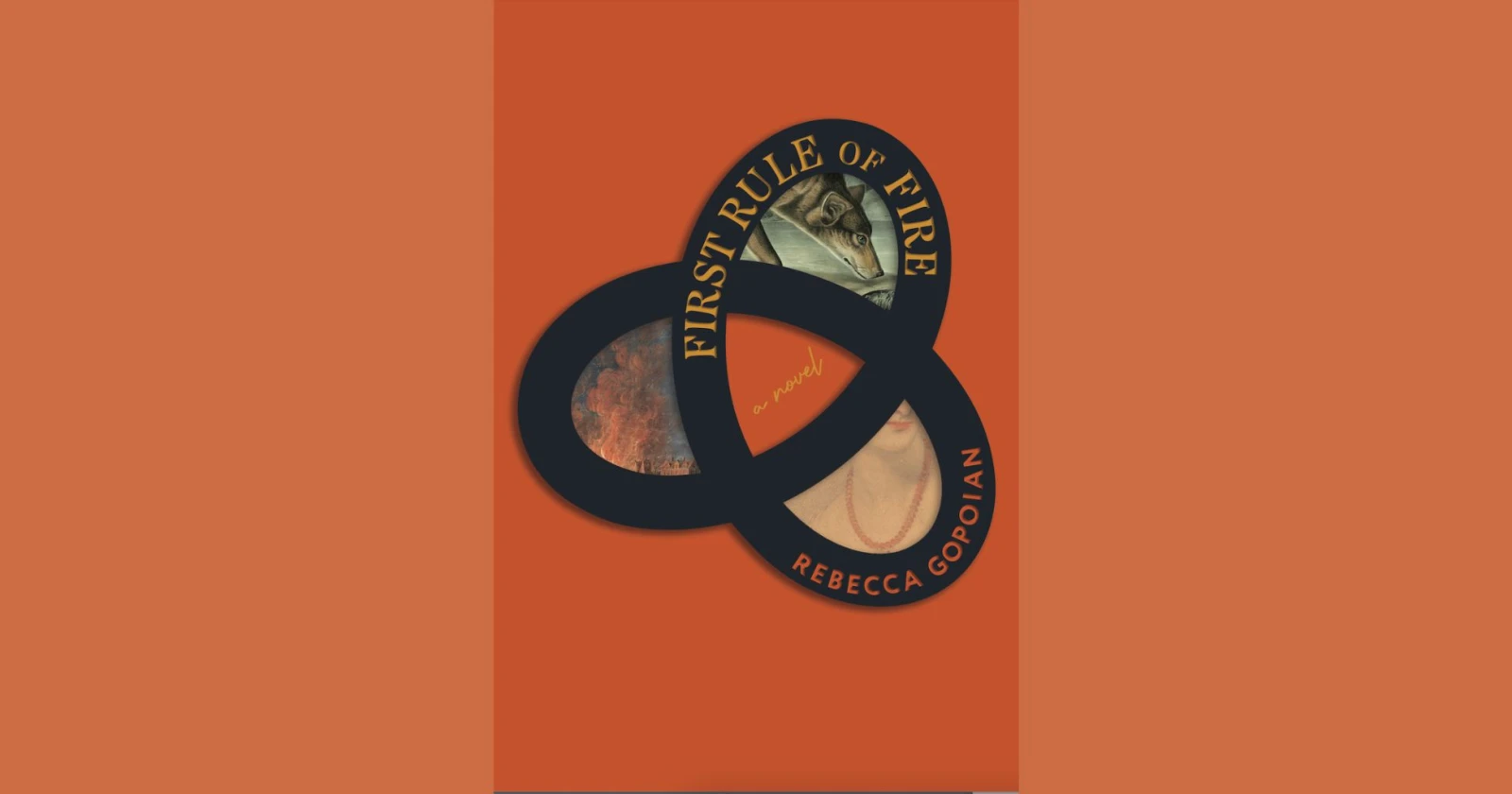
A review of First Rule of Fire by Rebecca Gopoian, a novel of the Armenian Genocide
Take the guns and put on a show.
Early in First Rule of Fire, Rebecca Gopoian’s novel of genocide, it’s the Armenians’ weapons the Turks are after. Whether it’s a hunting rifle, pistol, knife, or some combination, the army of the Ottoman Empire is going house to house seizing every weapon they can find. They know by now that most Armenian households have already buried their valuables underground for safekeeping. One might suppose the Turkish soldiers’ patience and energies are wearing thin.
In the richly described world of Gopoian’s novel – the old country so called, later on, by those relatively few Armenians who escaped it – much important action of ordinary life takes place on rooftops. Gopoian paints a picture of Armenian villages with houses set so close together that people routinely crossed each others’ roofs to get to another part of town, with the added benefit of a birds’-eye view into everyone’s private business down below. This was a useful fact of life. Rooftops were also essential for certain household chores, serious conversations, and spotting danger coming from far away.
Which brings us to the day of the weapons search. A decree hasn’t worked, nor has the threat of arrest for any Armenian who refuses. Something more is needed. The Turkish soldiers race through the streets, searching without finding, stirring up enough commotion to send everyone to the rooftops. Once the soldiers are sure everyone is watching from above, they drag the least politically involved, least resisting townsperson from his house and into the street, where they gruesomely beat him almost to death.
Everyone sees the show. Then they go to the yard, dig up their weapons, and hand them over to the Turks.
Reading this chapter in First Rule of Fire, I was reminded of the French Resistance fighter Jean Moulin’s 1940 letter to his family which included his early warning about the Nazis: Ils sont capables de tout. They are capable of everything.
It might go without saying that the beating episode helps to explain how the armies of the Ottoman Empire, between 1915 and 1922, were capable of killing 1.5 million Armenians in an effectively disarmed population. It might also be evident that the beating is the least brutal incident in the devastating history Gopoian patiently traces. She walks with her characters through long, inconceivably dangerous escapes out of the Ottoman Empire, into a Europe convulsed with war, and across the ocean to new lives in America – all the way up to 1981 in small-town New Jersey, where we meet their children and grandchildren. Along the way, her witnessing reveals a kind of machine logic to genocide. Eventually the reader realizes there’s not a thing in the world that can’t be used as an instrument of death if the murderer possesses sufficient motivation. Topography itself becomes a weapon, whether it’s rivers, deserts, or cliffs, and the least expensive approach to killing is one that simply sets the parameters and waits long enough for the human body to reach its limit. And then there are killings of the soul – rape, abduction, forced acculturation.
But in a story of mass death, First Rule of Fire courses with life. This is remarkable; it’s also not consolation and probably shouldn’t be. What Gopoian brings to life is a community that no longer exists, one that the Turkish army erased from the landscape but not from memory. In her lucid descriptions of life in Armenian villages, we see people eating, people being fed, caring hands preparing and serving. There’s cracker bread, beans, okra, yogurt, hand-rolled pastries, and many cups of hot coffee. There are fireplaces that must never go out because matches are expensive. There are worry beads that work strangely well, colored stones for warding off evil, coffee grains for predicting the future. There are the fascinating objects of domestic life in the old country: sleeping mats, baking pans, and most of all, textiles worked by hand. We become aware that this community prizes the fabric arts above all, a slow and patient craft practiced by men and women alike in an era before automation: wool-spinning, rug-weaving, cloth dyeing, tapestry-making, embroidering. The art’s highest form, and mostly the province of women, is dressmaking. Even as horrors unfold, there is not a piece of cloth that is not scrutinized for the quality of its production. It’s as if the characters, even in the midst of unimaginable suffering and loss, can’t quite help themselves.
On the one hand, maybe we recognize that the most exquisite human impulse, artistry, can’t be vanquished. On the other hand, think of all the dresses not made.
This painstakingly detailed book is the result of Gopoian’s extensive research into historical reconstructions of pre-1915 Armenian life, first-person narratives of the genocide, and the voluntary military service of Armenian men in the French Legion d'Orient. However, the primary inspirations for First Rule of Fire were the diaries of two survivors, the author’s grandfather Khazaros Gopoian and her father’s cousin Levon Gopoian. These eyewitness accounts provided the basis for the fictional story of Jivan, an Armenian teenager fleeing the killings. (Khazaros Gopoian’s diary and artifacts of his military service were featured in an exhibit at the Armenian Museum of America in Watertown, Massachusetts.)
It may seem like I’ve said a lot about this novel so far, but I’ve actually said little and given nothing away. First Rule of Fire teems with story far beyond what I’ve mentioned here, which is just a start to the conversations to be had about this book. There is the history, and those who wish to understand the Armenian genocide better will find this book deeply instructive. But in First Rule of Fire there is also a sensitive, nuanced exploration of trauma that transcends specific historical context. The people who survive and make it to America walk in a kind of fractured lens, forever cracked inside. We meet the character Araxie, a gifted clothing designer, in the surreal circumstance of a dressmaking competition in New Jersey. Here is the moment she steps to the front of the stage:
'Her breath pounded in her ears, but she forced herself to look straight ahead. Then – she couldn’t help it – she took a quick glance to make sure her dress was still intact. And of course, it was! How could a dress made with hundreds and hundreds of stitches suddenly come apart? Yet it had seemed possible, even though she had tugged on the stitches to test their strength. Yes. Threads could weaken even when they had been tightly held together before. The whole garment could come apart just because of one tiny stitch that wasn’t tied off properly.'
Such is the logic of the traumatized. When the fabric of life comes undone, when the human agreements by which we live completely unravel, suddenly anything seems plausible and the mind has no power to reason against it. And it’s not just in people’s minds, as Gopoian shows; that’s what makes it so hard to counter. Things actually do go off the rails. Things actually don’t behave by the usual rules. Araxie speaks of a stubborn, mysterious substance called muck that clings to her throughout her flight to safety. While pruning a vineyard, Jivan and his friend Giragos get caught in a locust swarm that disappears as quickly as it arrives. And then:
A group of Turkish villagers passed by and shouted at them, laughing, “You’re tending the grapes that we will eat!” They seemed to have missed the locusts entirely.
Gopoian skillfully brings forth the weirdness of sequence during traumatic events, the lurid juxtapositions that happen at no other time, the magical reality that takes hold after. Her characters are left forever trying to shake off the locusts, thinking they’re crazy, knowing they’re not.
****

Rebecca Gopoian’s novel First Rule of Fire, published by Nauset Press, is available now at Bookshop and Amazon.
Rebecca Gopoian received her MFA in Writing from the School of the Art Institute of Chicago. She is the author of a poetry chapbook, Terrible Person, and a book-length poem, Two, about becoming a mother for the second time. Rebecca lives in Queens and teaches English at Hostos Community College in the Bronx. First Rule of Fire is her first novel. www.rebeccagopoian.com

Mary Byrne’s fiction has appeared in Epiphany, Carolina Quarterly, the Under Review, The Massachusetts Review, The Honest Ulsterman, and 3:AM Magazine.
More work by Mary Byrne



Tel: 028 7126 6946
Email: hueditor@theverbal.co
Verbal, Stable Lane and Mall Wall, Bishop Street Within, Derry/Londonderry, BT48 6PU
 company
Copyright © 2026 Honest Ulsterman