

An exploration
Once upon a time when I was a student, I received (quite questionable, I’m inclined to think now) advice from a friend not to use the word ‘little’ so much in the poems I was writing. The suggestion was that it diluted the impact of what I was saying – it was non-committal, girly, excessive, childish, weak. Ultimately, it was unnecessary and, to the poem, not of value. These aren’t his words, but this was the feeling. I don’t remember exactly what was said, but the snagging rejection of this word ‘little’, for which I felt a strong affection (probably picked up from Gertrude Stein, a recent ‘discovery’) I have not forgotten. This exchange would have taken place around the time I started to become involved with various little magazines (although we didn’t call them that), both as an editor and a contributor. When I hear the term ‘little magazine’, it often comes to mind.
‘The littleness of the little magazine… has been a convenient, if problematic, qualitative designation used to identify the size of the audience, its physical dimensions, a limited budget for production, a paltry print run, and short duration, but is one or two of these qualities really enough to make a magazine ‘little’?’ Eric Jon Bulson raises this question in the introduction to his book Little Magazine, World Form in order to acknowledge the ambiguity of the category ‘little magazine’, the difficulty to be found in identifying a consistently shared defining ‘littleness’ across every manifestation of this ‘technology’, as he calls it.
What sort of ‘littles’ might characterise a little magazine? Print run, physical size of the publication budget and cash-flow, duration. But also audience numbers, size of contributor pool. Moreover, ‘littleness’ also rings through the ‘status’ of the writers and artists involved, often young, often as yet ‘little known’. This is perhaps one of the appeals of ‘little’ as a qualification in relation to small literary magazines: its contrast with the ‘big’ literary names that pass through them (en route, of course, to bigness). With an historical outlook, it’s usually for these ‘big’ names that little magazines tend to be deemed of ‘value’.
When asked to write this essay on the topic of ‘the Honest Ulsterman or the value of the little magazine’, I got caught up thinking again about this term ‘little magazine’. Granted, if both words are contracted (made littler) – ‘lit. mag.’ – its casual approximate-synonymy with ‘literary magazine’ seems to resolve with some serendipitous sonic satisfaction. Nonetheless, it’s always surprised me a little as the term for a key generic ‘technology’ within the stories of modernism and (now canonical) Literature. Among its strongest connotations are childhood (small, young, cute, unthreatening, vulnerable) and insignificance (brief, negligible, unimportant, just a little, only a little). ‘Little’ is often a diminishing, sometimes dismissive, qualification. It can expose both uncertainty and, often, affection. Littleness, moreover, is intimate – entangled – with nothingness.
I’m appropriating Bulson’s passing question as a launch pad – a justification, perhaps – for thinking more and more broadly about this idea of ‘littleness’. While, as Bulson (among plenty of others) points out, sometimes uncertain in designation, the term ‘little magazine’ is steadfast in discussions of twentieth century literary history (and beyond).
With that in mind, I’m indulging a curiosity: what might come to light in reading a so-called little magazine against the connotations of ‘littleness’ more generally. This essay can only be deemed a personal and preliminary little meander from this starting point, with a copy of the Honest Ulsterman (proverbially) to hand. But I can only hope it might spark, for someone, some other little (but valuable) questions around the topic.
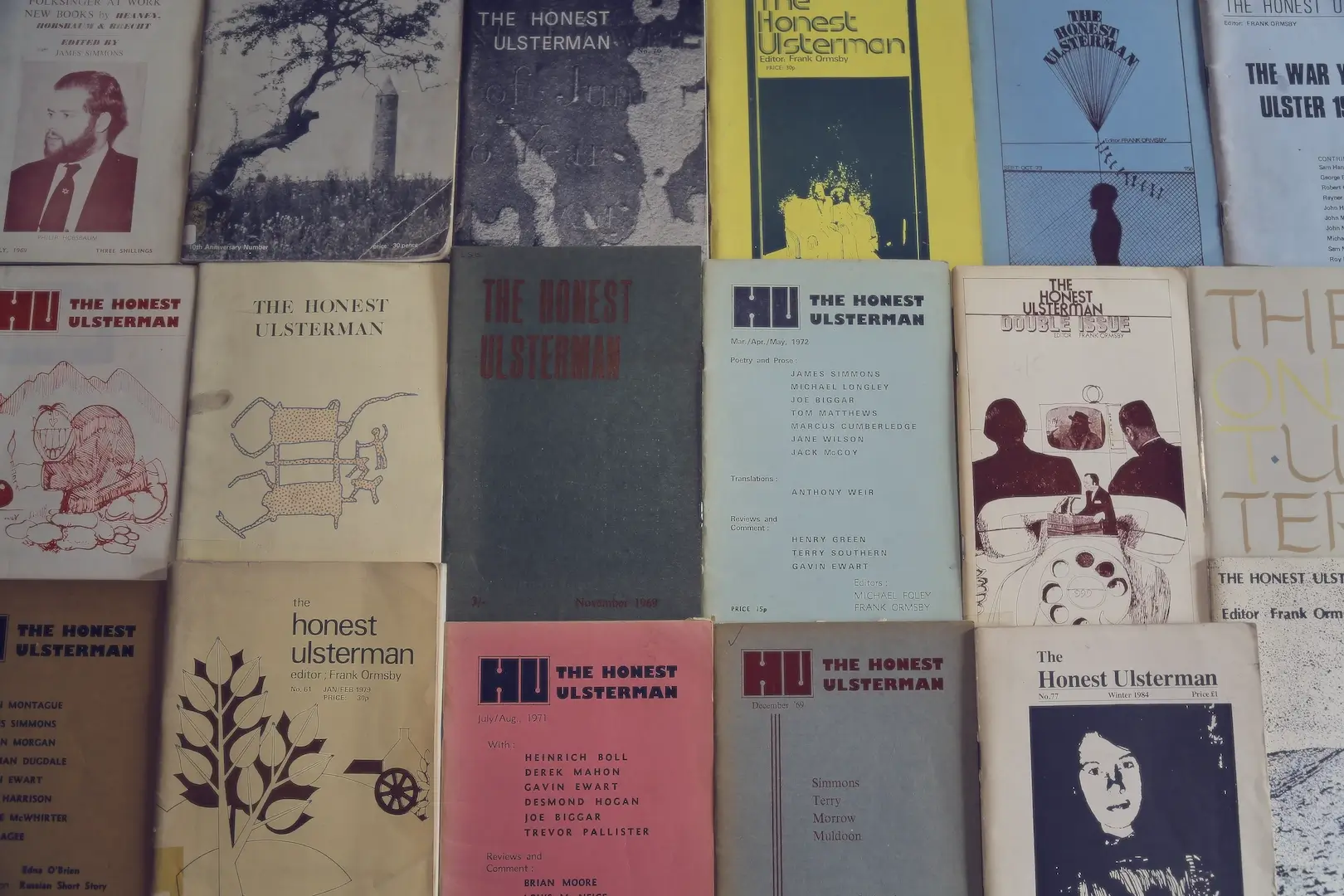
As established, as a medium of publication the ‘little magazine’ is (more than) a little blurry. the Honest Ulsterman fits the classical description in some ways but not in others. For one thing, it’s far from little in terms of overall print run and lifespan, having run fairly consistently (although diminishingly) as a print magazine from 1968 to 2003 (not to mention its metamorphosis into an online publication published in notably lengthy editions). I’m not going to get into a debate here on whether or not the Honest Ulsterman should be classed as a little magazine. That it often has been referred to as such is enough to have adhered to it the idea of the ‘little magazine’ – and, thereby, I’m going to venture – the notion of ‘littleness’.
Among other things, the littleness of the little magazine is tied up with an idea of liberty: freedom from the drives and constraints of commercial enterprise and its big money, freedom from the demands of large audiences and broad public taste, and a capacity to generate and facilitate freedom of thought and creativity. Littleness, it seems, can be a light-footed threat to what’s holding us in place. What’s little can sneak through the cracks, burst into bloom and, moreover, shock. In this way, The Honest Ulsterman’s tagline ‘a magazine of revolution’ follows a precedent set by other little magazines where notions of explosive rupture were built in from the start. (I’m thinking of the short-lived but blazing journal BLAST! (1914-15), where it’s right there in the name).
(It’s interesting to note the historical correlations between wartime and the emergence and persistence of little magazines, propping this notion up alongside, perhaps, the etymological link between magazine (periodical) and magazine (the cartridge for a rifle), both sharing a root in the Arabic word for storehouse. Is there an image here of the little as deceptively small, loaded, charged with explosive capacity for change? Could that change be generative or destructive? Are you thinking about a bullet or a seed?)
One of my favourite names of an historical little magazine is The Germ. An early example of one of those things we could call a ‘little magazine’, The Germ was initiated by the Pre-Raphaelite brotherhood in 1850. It only lasted for four issues (January, February, March and April of that year), and the name ‘The Germ’ was even more short-lived, the journal being renamed after two issues. Nonetheless it’s earned a place in the (art) history books due to how important its contributors ended up being (D G Rossetti, Christina Rossetti, John Everett Millais being among the contributors).
The reason I like the name ‘The Germ’ so much has to do with how it (now) seems to encapsulate this doubleness of littleness – coding generation, threatening destruction – I’ve started to wonder about in the above parenthesis. It also involves a little bit of an anachronistic indulgence in how its signification has warped through time. The traditional denotation of ‘germ’ as seed or bud and its burgeoning potential – preserved in the phrase ‘seed of an idea’ – is no doubt what the brotherhood had in mind, but a later meaning of ‘germ’ as a harmful microorganism associated with disease has become dominant in contemporary English. In any case, ‘germ’ suggests something small with great transformative potential, and the pregnant beginning of something, and there’s something to be gained by reading both connotations against the ‘little magazine’.
While it has nothing to do with the intentions behind this particular journal, I can’t resist dwelling with this latter connotation a little, and thinking there’s something apt about how it seems in keeping with many later little magazines’ hints at abrasion, disruption or danger, and also, on the other hand, the possibility of demise that hangs over their characteristic precarity. (Moreover, regardless of the success of any individual movement in spreading and taking root in culture through the vehicle of a little magazine, the past 100 years demonstrate fairly clearly that as a ‘medium’ within the literary world, the little magazine has been pretty infectious.)
Staying on the topic of names for little magazines (and, perhaps, the question of littleness and its value), I want to stop a minute with a little magazine whose name maps so closely onto the that term itself: The Little Review. Established in 1914, it is one of the foundational little magazines in the story of modernism. Ezra Pound was actively involved with its operations, and over its fifteen years (a relatively long run for a little magazine) its contributors included Amy Lowell, Djuna Barnes, T.S. Eliot, W. B. Yeats, and Gertrude Stein (from whom, just as an aside, I picked up that interest in and affection for the word ‘little’ as a poem-writing-student). Perhaps most famously, The Little Review first serialised James Joyce’s (not very little at all) Ulysses. As a result copies were seized and burned by the US Postal Service and the editors charged for obscenity.
There’s an enormous amount to explore in and around The Little Review, far beyond the scope of this short pondering. It was radical, experimental, interdisciplinary, feminist, transatlantic, founded by a woman and run by an openly lesbian couple (Anderson along with the artist Jane Heap, who took later took over the editorship) and (in classical little magazine form) was the launch-pad for some of the biggest names in 20th century arts. The Modernist Journals Project (modjourn.org) hosts a digital archive of this particular little magazine, among many others. I’d highly recommend a leisurely exploration of their website (which unsurprisingly has a lot in common in terms of drive and function with our regional and emergent huarchive.co).
The Little Review is typical as a ‘little magazine’ in being valued most highly, in posterity, for giving a platform to a generation of Greats who (according to Anderson) could not get published elsewhere at the time, but also of note are its avant-garde gestures. An anecdote I particularly enjoy has to do with the September 1916 issue, which featured 13 blank pages. The story goes that there was not enough acceptable work submitted to the magazine that month, so the editors – also keen to make a shift into publishing more art in the journal’s pages – decided to present the issue as a ‘Want Ad’. The first page reads: ‘The Little Review hopes to become a magazine of Art. The September issue is offered as a Want Ad’. It’s a disruptive, playful, rather cheeky conceptual gesture, but – more than that – it's a radical invitation to participate, handing the blank page back to the reader. (An aside: to plant a seed for, perhaps, future pondering – how much does ‘hope’ have to do with the value of the ‘little magazine’?)
‘Little’, in conversation, can mean ‘hardly at all’, or ‘almost nothing’. Little is, as I’ve said, intimate with – derives its meaning from the ground of – nothing, absence, what’s not there at all. Absence is a fascinating and, I would argue, fundamental cog within the little magazine machine. By their very creation, most little magazines propose to address – and thereby, firstly, identify – an existing gap in culture. Something missing. Something overlooked. Something in the margins that deserves to be seen. Very generally speaking, a little magazine – in its littleness – doesn’t (shouldn’t) present itself as the complete missing piece of the puzzle, but rather as a signpost or gesture toward an open door: an invitation to think beyond what’s ‘out there’ already, to think into the gaps. The little – like a scattering of crumbs – indicates, by proximity and association, what’s not there: what’s possible, as well as what’s gone. The September 1916 issue of The Little Review seems to me to make this (valuable) capacity of the little magazine delightfully materially manifest.
There are many ‘types’ of absence with which the little magazine (and, thinking big, literature in general) is definitively intertwined with. But for now, how about this question what sort of absence comes into being when a little magazine stops, or disappears? Very often this happens without warning. Many little magazines seem to be over before they really begin, never getting beyond a riling rhetoric of aspiration. Exploring the H.U.M.A.N. archive, I was quite taken with Rhinoceros magazine, edited in Belfast by Martin Mooney, Patrick Ramsey and Kevin Smith, which I have to admit to only discovering here. Among its contributors I find (unsurprisingly) a number of parallels with its local contemporary the Honest Ulsterman (such as Medbh McGuckian, Gerald Dawe, Paul Muldoon, for example) and, more surprisingly, in Issue 3, beat generation great Allen Ginsburg.
The editorials of Rhinoceros narrate something of a dance with absence, with this dimension of the little. The editorial of Issue 1 articulates aspirations toward challenging what’s available and making space for valuable work that’s not: ‘Rhinoceros aims to give breathing space to both writer and reader, room to stretch the legs of the imagination and the intelligence… … we want to question the orthodoxies of taste and interpretation, to protest the inflexibility of habits that see themselves as traditions, and to draw in good word from outside the mainstream…’ . The second discusses a lack of submissions from women, reaching out, it seems, to the reader for a way to address this: ‘... we have been taken aback by the sheer imbalance between male/female contributors… It would not be an exaggeration to say that for every unsolicited mss from a woman poet, we have received at least ten from men… … The editors are somewhat baffled as to how to begin to rectify this situation… We would be very interested to hear what our readers/contributors think…’. Then, suddenly, the editorials disappear altogether from issues 3, 4 and 5. And then, apparently, so does the magazine. I don’t know what happened to Rhinoceros (perhaps someone reading this does?). I’m not even sure if there were indeed more issues, and it’s only that the issues that have made it to the archive are limited to these 5. I haven’t been able to find out. It is certainly a shame if it wasn’t (as seems to be the case) able to continue as it set out to, but this is also such a familiar story in the world of little magazines, and, often, so intrinsic to their ‘littleness’ – how it feels, and the ‘value’ it carries.
Dissimilarly, the Honest Ulsterman (in its original form as print magazine) does not disappear without warning. In the editorial of the Summer 2003 issue, current editors Ruth Carr and Tom Clyde state that they feel it’s ‘time to sign off’, and the issue is offered as their last. Hopeful emphasis is put on the possibility of it being resurrected by another editor (‘... don’t be surprised to find the HU re-emerging in the months to come, under new editorship and in rude health…’), and the editors turn to the metaphor of a wildflower here, and its capacity to pop-up from barren ground.(I think of The Germ again, of seeds, resistance, possibility… ). But overall it’s clear that there is no plan in place for such a continuation. The mantle hasn’t been passed, but set down, and whether someone will pick it up again (whether it will indeed take root again or, moreover, flower) is an unknown. A lacunae, at least, is being declared.
In fact, it is never picked up again as a print journal, and while it does (as we know) still live on in a metamorphosed digital format, the online version of the HU didn’t come into being until 2014. Moreover, the 2003 issue is late, the editorial opening with an apology for the ‘long delay’. The ‘demise’ of the print magazine is anticipated, it feels, by a pause (emptiness) between 2001 and 2003, a two year period where no issue materialised. An absence of eleven years, and the entire disappearance of the HU as a physical magazine, was to follow.
‘... [W]e feel that things have come full circle’, state Carr and Clyde. The final print issue is, primarily, a tribute to the Honest Ulsterman’s founder, James Simmons, who passed away in 2001. Elegy, then, runs all the way through this issue which materialises around a loss, an absence. Unlike those of other little magazines that stopped all of a sudden, their adolescent and aspirational rhetoric suspended in (it seems) silence, this final (‘for now’) issue is already looking back, already reflective, even nostalgic, endowing the magazine with an of-the-past-ness. Drawing a circle, re-uniting the magazine with its founder, laying it down with him, almost, this issue also articulates a sense of wholeness, or completion, that pushes and pulls against the implications of loss, absence, demise, disappearance.
The Summer 2003 issue is ‘Issue 111’. Why do I find this so satisfying? There’s something, it feels, profoundly un-closed about this ragged-end number. In my current preoccupation, I can’t help seeing in it a typographical echo of the word ‘little’. Or, actually, a sort of pictogram of a series, of the spines of periodicals lined up along a shelf, that might continue or stop at any time…
Issue 111 also features an ENDNOTE penned by Ruth Carr. Here she reflects on her shifting ambivalence around the name of the little magazine: ‘When I first became involved with the Honest Ulsterman in 1986 I had some reservations about the name… When Tom Clyde took over we both agreed to shorten the title to HU… Perhaps it is age, but I now feel an affection for the original title… Why stop at reinstating women, I want the whole heap! I want to reclaim ‘man’, or rather, transform it into a truly generic and inclusive term for whomsoever, and woe betide those who cannot see the humour in it.’
Contracted, the name of the Honest Ulsterman became literally littler, but, in another sense, less specifically loaded and, therefore, broader, more – perhaps – expandable. I like the name HU, which has continued into the post-2014 digital version, appropriately (I feel) acknowledging both its origins and its distance from these. (The Honest Ulsterman/HU is not ‘little’ in a temporal sense, and its lifespan means that – unlike the more fast-burn, short-lived of little magazines – a history of adjustment is a necessary part of its identity). One thing that ‘HU’ lost, however, was the word ‘honest’, which really has so much to do with the ‘value’ of the little magazine as an endeavour, ringing with its aim to break through commercial expectation, with the human efforts that underlie them.
Issue 111 (Summer 2003) is, as I have said, primarily a tribute to James Simmons. Alongside poetry by Simmons himself (one including the poignantly reverberating line ‘It was, days ago, a life’), most of its pages are filled with letters, memories, and poems dedicated to or in memory of Simmons and/or his family. But there is also a section of new poems, distinct from this circle of tribute. (In these are we to glean a sense of potential for renewal or continuation, even the little seeds of the wildflowers cast (with hope) into the silence of barren soil?) A message precedes this section on Page 80: ‘PLEASE NOTE: As this issue is primarily a tribute to the late James Simmons, we regret that, due to limited space, it has been possible to include only one poem from each contributor.’ Here, a reminder of the littleness of the little magazine – its limitation, the necessary slightness of its scattering.
I am surprised to discover – because I had forgotten entirely it would be there – my mother’s name amongst contributors to this section of the final print issue. I’ve written about this before (see ‘Exploring the HUMAN…’, hu.org, 2017), but the presence of my mother’s name and poems in a few copies of the Honest Ulsterman is not only the first (and strongest) anchor of my personal relationship with the HU, but – I’m adamant – speaks to something vital and easily overlooked about the (valuable littleness of) the little magazine in general.
My mother is a little known poet. In fact, her publishing history is almost entirely confined to three issues of the Honest Ulsterman. She never published a collection. She is not a ‘name’, and now would be far from comfortable referring to herself as a poet. And yet, here she is, her voice and her name, printed amongst what would become (if they weren’t already) some of the biggest names in Irish poetry (and revived, now, in the online archive). In this respect, she is far from alone. I’ve made this point before, but I’ll make it again: little magazines retain a trace – a little, and a confirmation, even – of ‘little’ names in literature (those that never become ‘big’ or attached to a collection or single-authored work or prize etc.) is one of the functions for which, I think, they should be most valued.
Any issue of a little magazine is beholden to a short contextual period of time. (I wonder if it’s worth venturing that this is one of the main things that, usually, sets a magazine apart from an anthology. The etymological root of anthology is a collection (although arrangement might be more apt) of flowers, perhaps to be compared with Carr & Clyde’s wildflower metaphor?) It strikes me, returning to it, that the poem of my mother’s featured in this issue chimes so much with this idea: the constellation and suspension of a little moment…
HOME FROM THE HOSPITAL
Jack’s green beans were waving
swaying blue and gold, as if underwater
in the garden he had hewn and hoed
broken and roasted his back for
humping quarry stones
building walls.
The perfumed damson velvet roses
hung clasped like bees in amber
in that hot crystal afternoon
where you balanced with your back to me
engrossed in something
enraptured, gathering up sensations
greedily ecstatic to be home.
You hadn’t heard the crash as I
dropped my bike to the driveway
stones nor the scolding I caught
for being ten – for being late –
as the garden was held quite apart
in a bright bowl of burnished quiet.
As I stood there watching you
you turned, ‘Hi, Jan!’, and leapt
from the wall on your wounded leg
sun prancing off your skin in stars.
I can replay this scene like a film – me suspended
watching you, you suspended from the wall –
the brilliant light, the encapsulating stillness
my chest heaving open – and you, my small
brother, shining, smooth and sound as a nut
gilded, that instant, on my inner eye.
JANET GALBRAITH
Aside from everything else it connotes, ‘little’ is something of a term of endearment. We use it to express – to reveal – affection. And we use it most often in reference to children, their things and their world. This is the world of this poem – the home-sphere of childhood. What’s communicated by the speaker – retrospectively, remembering – is the sensual enormity and intensity of this small world, this tiny exchange. It’s a poem not only for a child – a little one – but for one of those ‘instant[s]’, those momentary imagistic experiences that hook onto the ‘inner eye’, the ‘gilded’ full-colour of which we never lose our sense of. It’s a moment full of emotion, and moment before speech: the speaker is greeted and named – ‘Hi, Jan!’ – but the poem ends before they respond. The reader must accept the poem as its own response, journeying brilliantly and imperfectly through time, delayed, slight and ‘heaving’.
Here, the poet defamiliarizes a familiar use of the word ‘little’, using, rather than the standard ‘little brother’, the term ‘small brother’, making the reader feel smallness, think about material size in addition to relations through time, jolted from the conversational. It’s loaded with affection, as is the poem as a whole. Tantalisingly so, achingly so, because of the brevity of the experience we’re dealing with, because it is so distant and yet so sensationally present to the speaker, and, by extension, the reader.
‘I can replay this scene like a film – me suspended / watching you, you suspended from the wall…’To suspend is, I think, the most important verb active in the poem, they key to its energy. Not only precise imagistic details but names – ‘Jack’, ‘Jan’ – are suspended within it, ‘clasped like bees in amber’ – that is, held still through time in another element that endows them with a warm and otherworldly light (a poem, a page in a book of poems).
The root of the word ‘magazine’, as I’ve already noted, has to do with storage. Coming back to this poem – which I have known for a long time, though I’d forgotten where it had appeared in print, and which seems to occupy and articulate a flickering realm between littleness and enormity, brevity and reverberation – while thinking about the ‘little magazine’, the nature (and ‘value’) of its littleness, the HU issue that crackles at the threshold of not-being-there, I can’t help feeling correspondences. No matter how long it lasts, how ‘little’ it is in terms of size, print run, duration, even audience, as an historical trace the little magazine suspends – preserves in the element of publication – fragments of names, moments, images, ideas, and their dynamic constellation with others within its covers. An archive like huarchive.co, moreover, re-illuminates this element, lets us see them and the absences that surround and interact with them again, and in a new light. (‘... sun prancing off your skin in stars.’)
__________
Sources
A Magazine of Revolution? An Exploration of the Honest Ulsterman, https://www.huarchive.co/items/show/259
British Library online collections: https://www.bl.uk/collection-items/pre-raphaelite-journal-the-germ
Bulson, Eric Jon. Little Magazine, World Form. (Columbia University Press, 2016)
Churchill, Suzanne W., and Adam McKible. “Little Magazines and Modernism: An Introduction.” American Periodicals 15, no. 1 (2005): http://www.jstor.org/stable/20771167.
Etymonline: https://www.etymonline.com
Modernist Journal Project: https://modjourn.org
HU Summer 2003 (Issue 111): https://www.huarchive.co/items/show/119
Rhinoceros magazine Issues 1-5: https://www.huarchive.co/collections/show/24
‘The Little Review’, Community of Literary Magazines and Presses: https://www.clmp.org/about-independent-publishing/history/the-little-review/
This essay has been funded by the Foyle Foundation and can be also found at www.huarchive.co

Susanna Galbraith (she/her) is from Belfast. She is a Poetry Ireland Introductions 2023 selectee. Her recent poems have appeared in New England Review, Berlin Lit, Propel Magazine and others. Her first pamphlet is forthcoming with Nine Pens Press, 2024. She is also an editor of Abridged
Follow her on Twitter @susannaalice
More work by Susanna Galbraith



Tel: 028 7126 6946
Email: hueditor@theverbal.co
Verbal, Stable Lane and Mall Wall, Bishop Street Within, Derry/Londonderry, BT48 6PU
 company
Copyright © 2026 Honest Ulsterman