

An Interview
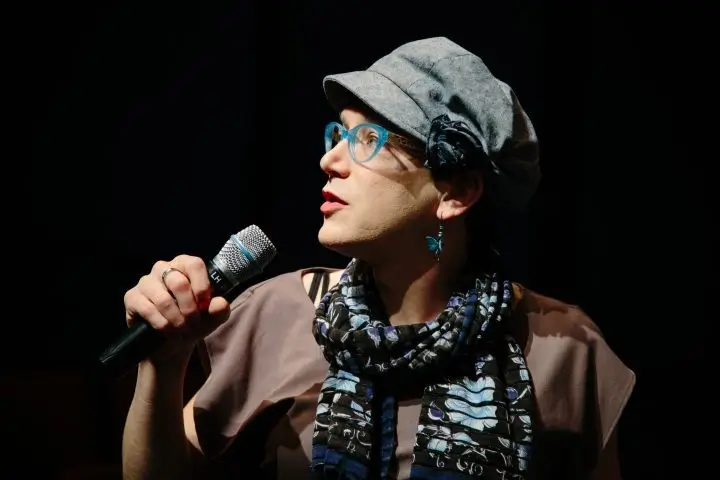
Stephanie Burt is a literary critic, poet, and professor at Harvard University. The New York Times has called her 'one of the most influential poetry critics of her generation.' She is the author of several books of poetry and literary criticism, among them The Art of the Sonnet, with David Mikics (HUP, 2010), Close Calls with Nonsense (2009), The Forms of Youth (2007) Belmont (2013), and Advice from the Lights (2017). She edited The Poem is You in 2016. Burt's essays and reviews appear regularly in ALH, Boston Review, the New York Times Book Review, and several other scholarly and popular venues in Britain and America.
Gregory McCartney: Thanks Stephanie for being in the HU.
Stephanie Burt: Thank you.
GMCC: You’ve described yourself as coming from a Washington, D.C., bourgeois upbringing. I always hate asking people how did it all start but was there a moment you thought a writer was something it was possible to be? Did your background make that easier? Or was writing a form of rebellion from that?
SB: My background made it easier to be the writer I’ve become in so, so many ways, in part because the kind of writer I am—a critic and poet with one and a half feet in the academy—is the sort of writer that DC’s elite institutions are pretty good at trying to produce.
My parents—who may well read this interview; they’re still in DC— do not share most of my tastes or interests (although my mom likes George Eliot and my father used to watch Star Trek with me, so that’s something) but they have been consistently encouraging and supportive, and while I knew I would have to find a job as an adult—I don’t have a trust fund—I could go to used bookstores at age 14, 16, 18, 22, 26, and buy a stack of paperbacks without having to worry about whether or not I’d eat, or own shoes, or pay rent. That means a lot.
The topics in my writing are, certainly, rebellions of a sort—I write about resistance to patriarchy, about allegorical and sometimes about literal trans liberation—but my overall choices about what to write and where to publish and how to be a public figure, as a writer, are choices that my liberal coastal elite upbringing has certainly rendered easier to make. I have tried to support writers (and musicians and comics artists) who came up almost entirely outside the institutions of academic literature (April Daniels comes to mind), but some of those institutions have made some efforts, themselves, to support rebellions, and they have certainly been good to me.
I’ve also had very good individual teachers, which isn’t a guarantee no matter where you go to high school or to college. Gary McCown, John Burghardt, Helen Vendler, and Lucie Brock-Broido come to mind.
GMCC: You have a quote from Tracey Thorn (of Everything But the Girl fame) at the start of the book where she describes being absolutely connected to the songs she’d written and hoping that the people around her were as connected and understanding of them. And many people were, particularly to indie music in those days. Would you consider maybe that poetry still has that connectivity and that indie spirit?
SB: Is “indie spirit” one thing, or several? I hope that my poetry finds people who feel absolutely connected to it in the way that Thorn hoped her earliest songs would find that kind of connection. At the same time—and it’s one of the neat threads running all through Thorn’s first book—you can grow as an artist, if you let yourself, by thinking about how many other people, people who are not just like yourself, might also hear, or read, the art you make. On the one hand, you make art for yourself, and for people who might be just like you. On the other hand, you make better art if you try to learn from people unlike you, to say “what would they do? how would she sound? What would he think?”
GMCC: A part of the indie spirit was the perception of its independence and given that in the book there are poems about your imagined childhood as a girl do you feel if it makes sense a disconnect to how you grew up in mainstream so to speak circumstances? A ‘non-attachment to what was [your] skin and [your] clothes?
SB: Again, was there one “indie spirit”? Did the Raincoats and the Blue Orchids and Blueboy and the Blue Aeroplanes and These Animal Men think they were doing the same thing? I’m not sure. But they all thought they were, somehow, independent.
Really nobody is wholly independent. We need other people if we are going to become who we are. But we don’t all need the same other people, and we do not need them in the same way, and we do not all benefit from, nor rely on, the same conventions and institutions. Some of those conventions are bad for everybody; others are bad for us.
The culture around independent or “underground” pop and rock music during the 1990s, most of all (but not only) the very nonconfrontational, “twee” (this word was not an insult in those circles) indiepop scene around Sarah Records in the early 1990s—these things were very important to me back then as a way that I could find my bearings, find reference points, friends, works of art I admired, outside the academy, outside poetry, outside the space where I wanted to make my artistic—and professional—primary home.
More here: http://hilobrow.com/2018/01/03/wowee-zowee-1/ Also here: https://queenmobs.com/2016/06/20174/
GMCC: You announced your transition from Stephen to Stephanie on Facebook which given the battlefield that social media has the potential to be took a lot of strength I thought. As writers, people make the ‘personal’ public through the conduit of a book and then wait for the responses and reviews. How did it feel to be as open and direct as you were?
SB: Surprisingly not hard. I took years and years to come out, announcing that I had two genders and then discovering, and only then explaining, that really I wanted just one; I went very slowly, and I already had a supportive family and strong queer friendships (though they have become stronger!) and a birth family that would understand. Also I had tenure, which helps. Financial security, or the lack of it, doesn’t get examined enough when we think about people’s psychology, about motivation, emotion and big decisions. There should be more poems about it (Langston Hughes wrote some).
It hurts to keep secrets. (That doesn’t mean you can or should tell everyone everything about yourself; in fact, as a very good book by Denise Riley explains, it is literally impossible to tell or show everybody everything about yourself—that’s part of what it means to have a self. But keeping big secrets from everyone, and living in ways that are wrong for you, sucks. It feels good to stop.)
GMCC: I noticed when we did the Abridged reading in Cuirt last year that you have a very generous and engaged relationship to the audience (to which people responded enthusiastically) whereas I generally try to hide onstage. Is the public part of poetry something you enjoy?
SB: Very much so, especially now. Maybe too much so. I have been told that when I was a very young child I announced to my aunts and uncles “I want all the attention I can get!” That may still be the case.
I like being a literary critic—and I like collaborations—because if I’m good enough I can help draw deserved attention and approbation to people who are not me.
GMCC: I love the last verse in ‘Royal Botanical’: ‘Dear travellers, dear/gardeners: do not ask us to go back/ to an order in which you no longer believe’ It strikes me as if there’s a perpetual struggle between the present and the past. In my neck of the woods that’s a given. Is nostalgia a danger particularly in the current US climate?
SB: In the current US climate it’s also an asset, because we need to remember what having a basically functional government with a competent chief executive and thoroughly professionalized law enforcement was like. Some parts of US tradition, and some orders and institutions are just indefensible—we’ve never treated immigrants, and never treated First Peoples, fairly!—but some parts are very much worth preserving, rather than wrecking, so we can improve them.
I’m radical about opposing patriarchy and transmisogyny, and I have pretty left-wing views about distributive justice, but I am very sceptical about calls for revolution, for tossing the whole past out, for changing everything at once; I think habits and institutions and traditions can be very good things, especially when the opponents of those institutions are malicious racists who want to turn the clock back a hundred years. We can fight them more easily if we remember how hard we worked to get here, and what things were like twenty years ago, and ten, and four, and two.
Poetic traditions are part of that struggle too. More here: http://bostonreview.net/literature-culture-poetry/stephen-burt-reading-yeats-age-trump
GMCC: ‘The President has never/Owned the rain’ I don’t want to ask (as I always do) how does it feel being a poet in the Trump era so maybe I could ask how do you think a Trump era came to be and how does one respond to the forces that birthed it?
SB: Historians know that all monocausal explanations for any significant event are always wrong. I’m not a historian but I can propose a few contributory causes: racism; the shrinking of white privilege, and white backlash in consequence; vastly increased, and very visible, economic inequality, whose victims (not only white victims) look around for someone to blame (and some of the white victims blame non-white people, as well as blaming snooty coastal elites); institutional failures on the part of the US Democratic Party, whose local branches President Obama did not work to build (this is like living somewhere with torrential rains and not cleaning the gutters on your house); the cult of celebrity; the thirty-year, Murdoch-fueled growth of the right-wing media…
How does one respond? Through local involvement in local institutions, as well as (of course) through calling Congress, showing up at protests, and reminding everybody to vote if you can (I recognize that many, probably most, readers of the HU are not American and do not vote where I vote).
One of the great things about the United States is that we have decentralized institutions. Trump can pardon himself for federal crimes, if the Mueller investigation goes that far, but he can’t pardon himself for breaking the laws of the state of New York. Trump can try to block federal agencies from enforcing the Clean Air Act, and his lackeys do try, but he can’t block the state of California from enforcing its state laws, nor can he stop our town in Massachusetts from seeking renewable energy. He can’t even do much to influence local elections (though he can decide not to bother investigating if the Russians do). Get involved where you are.
GMCC: You’re a very respected critic and academic writer. How does working in those sometimes quite restrictive formats fit with your poetry writing? Is there more freedom with the latter? Which do you prefer?
SB: I prefer to do several things at once! Each one has its own limits and its own affordances. I don’t think I’ll ever stop writing nonfiction explaining why I love the works I love—the poetry, and also the novels, songs and comic books— although I may someday dial back my commitment to writing the sort of thing that has 50 readers and 50 footnotes.
Poetry does come with a sense of freedom, but it is, also, all about me. I like writing about poems by other people (and novels and comic books and songs) because I’m already automatically engaged with someone and something that’s not me. Also because it’s practical work, it’s a craft. An essay can do its work of recommending or explaining a poet or a poetic phenomenon even if the essay ends up inelegant or not quite as it should be. Poems, for me, have a kind of all-or-nothing energy about them—either the poem really works, or it really falls flat.
GMCC: You edited ‘The Poem is You’ a new and very important anthology of American poetry from the 1980s to now. Anthologies of Irish and British poetry have recently come under scrutiny for who they traditionally have excluded i.e. women and any minority you care to mention. How did it feel to be on the other side of the bar so to speak as an editor? Was there a sense of responsibility to the ages maybe?
SB: More of a sense of responsibility to the next, say, twenty years of readers, and to the poets at work now. Any good anthology can last five years; almost no anthology, and very few works of literary criticism, last fifty (although the best do).
I’m a white queer lady with an elite coastal background, so of course the things that have come to my notice most easily have been whiter and more queer and more tied to elite institutions than American poetry in general. I’ve worked to correct that skew, though sometimes I worry that I haven’t worked hard enough.
GMCC: And who in it would you recommend to our readers? Though of course maybe they should just buy the book!
SB: I recommend everyone in it!
GMCC: What are you listening to at the moment? Does music still influence you as much as it did?
SB: “As much” is a high bar, since for part of the 1990s I organized most of my life and most of my friendships around indie music. I would not want to live that way today, and I probably discover less music per unit time than I did back then, because I devote more time to other things, like parenthood, and superhero comics, and, frankly, keeping up individual friendships, which I like to think I’m better at now.
That said, of course I still care about music. Today I listened to John Cale’s “Fragments of a Rainy Season,” “Waiting for Something to Happen” by Veronica Falls, “Supercalifragile” by Game Theory, and new singles from Patience, the electropop project from ex-Veronica Falls singer Roxanne Crawford. Indiepop people encountering me for the first time should probably know about Allo Darlin, by far the best indiepop act of the last few years.
GMCC: Finally, What was your favourite year?
SB: Big fan of 2006 and 2010, because during those years our kids were born.
GMCC: Thanks for being in the HU!
You can buy Stephanie's latest book of poems here: https://www.graywolfpress.org/books/advice-lights and 'The Poem is You' here: http://www.hup.harvard.edu/catalog.php?isbn=9780674737877

Dr. Gregory McCartney is the editor of Abridged, the HU and an independent curator.
More work by Greg McCartney



Tel: 028 7126 6946
Email: hueditor@theverbal.co
Verbal, Stable Lane and Mall Wall, Bishop Street Within, Derry/Londonderry, BT48 6PU
 company
Copyright © 2026 Honest Ulsterman