


The work of Callahan

"Dark" is certainly one way to describe Callahan's humor. Many called him "politically incorrect," others simply "tasteless." But the cartoonist preferred another term—"survivor humor."’ [1]
“On the last day I walked, I woke up without a hangover. I was still loaded from the previous night” [2]
Out on the lash later that night and a (very drunk) passenger in his own car the driver mistaking a ‘Con Edison Pole for an exit’ ran into it at 90 miles an hour causing only minor injuries to the driver but neatly snapping Callahan’s spine. [3] Not that he noticed, he was far too drunk.
You couldn’t escape the Catholic Church particularly if you were Irish and had emigrated to the United States, indeed it was mostly willing packaged up along with some clothes and a little money with those that boarded the boats. Hence as soon as Callahan was born in Saint Vincent’s Hospital, Portland to a single mother he was removed (he reckoned to disallow any possibility of bonding with his ma) to the care of Nuns for six months then given to the Callahan family as an adoptee. He did actually later in his life search for his birth-mother:
‘A protracted search for his birth mother ended with the discovery that she died after going over a cliff in a car full of nuns when he was 12. "All these wrecks," Callahan said. "It has to be genetic." ’[4]
Growing up he was an energetic kid but as he entered his teens he was already beginning to develop a drinking habit. He admitted that it was possible that being abused by a woman who was not a family member (he wouldn’t say who though it may have been a female teacher) may have contributed (in tandem with heredity) to his burgeoning alcoholism and to his occasional misogynistic cartoons. At any rate the crash it goes without saying) changed his life completely:
‘The injury left him a quadriplegic, paralyzed from the diaphragm down. Even his upper body mobility was extremely limited after the crash. Thus, at only 21 years of age, Callahan had experienced sexual abuse and suffered the consequent emotional damage, turned to alcohol and drugs, and suffered a spinal cord injury. His life seemed defined by pain and struggle.’ [5]
He spent the next three years in various institutions and nursing homes trying to as best he could recover, not helped by his continued heavy drinking. The turning point (so to speak) came when on a binge, he dropped his bottle and with nobody around to pick it up couldn’t reach it, and suffered an existential as well as very real breakdown, eventually phoning for help and entering Alcoholics Anonymous. This was a type of epiphany and he realised that it was alcoholism rather than being paralysed was at the bottom of his problem and though aged 27 he was emotionally still a child.
Cartoons.
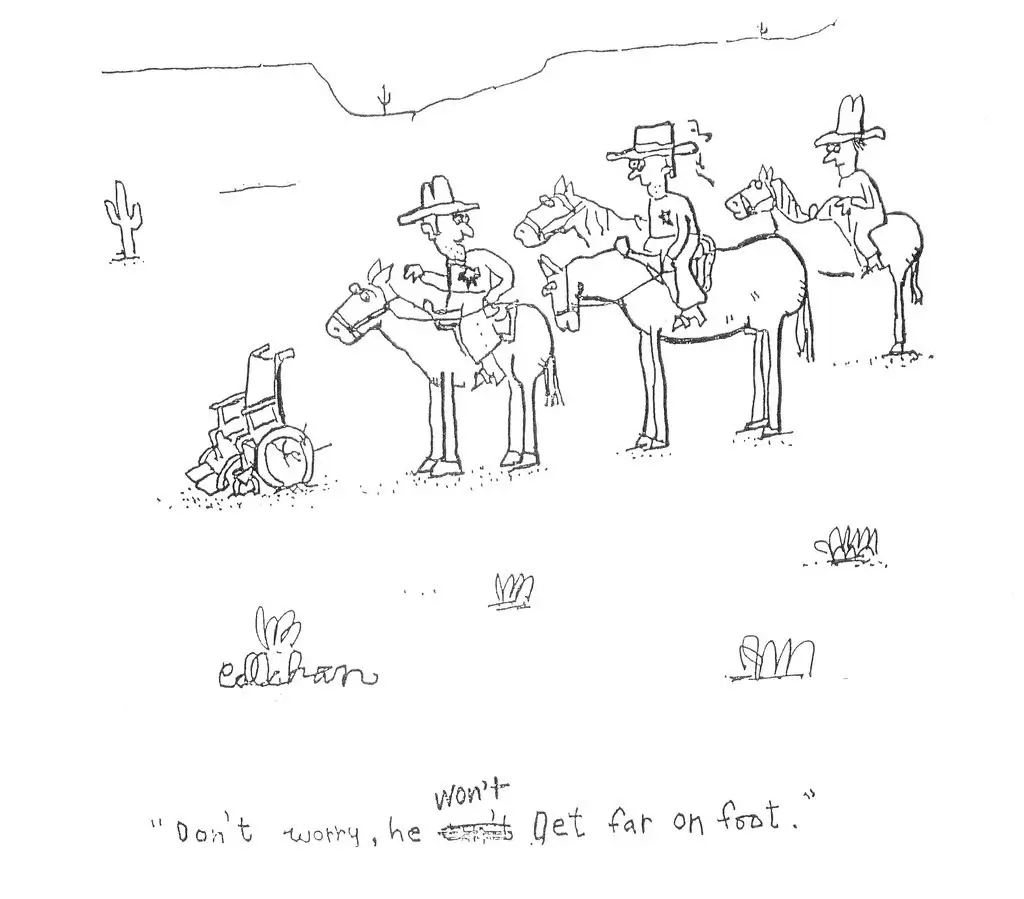
“This is John; I’m a little too depressed to take your call today,’’ the message on his answering machine said. “Please leave your message at the gunshot.’’ [6]
What we now see as the social media driven ‘inspirational messaging’ and pseudo-confessional culture could be said to have had its beginning in American television of the 1980's and 1990's. As has been noted:
‘Bemused by the culture of confession and self-help fostered by the likes of Oprah Winfrey, Geraldo Rivera, and others, he was disinclined, in his work, to be outwardly sympathetic to the afflicted or to respect the boundaries of racial and ethnic stereotyping, and his cartoons were often polarizing: Some found them outrageously funny; others, outrageously offensive.’ [7]

And this is why Callahan remains a vital response to the pseudo-good Samatianism of the social media age and the rise of a puritanism on the Left that mirrors the growing (and sadly populist) intolerance of the Right. I wonder what he would’ve thought of what possibly was the nadir of confessional television: the Lance Armstrong interview with Oprah.
After joining an AA programme he eventually enrolled in Portland State University and began to draw cartoons. He had always loved drawing and despite the difficulties in doing so he started publishing drawings in the University publication Vanguard. His disabilities meant that he couldn’t hold a pen properly so the drawings were shaky or wavy and quite minimalist but completely unique. They were also very un-PC. The local paper, the Williamette Week published his first cartoon in 1983 which featured a nun walking a penguin on a leash down the street. The newspaper observed that it got more hate mail about Callahan than anything else.
The cartoons were visceral, funny and for many well beyond the pale. There’s the cartoon about an aerobics class for quadriplegics where the instructor says’ Ok, Lets get those eyeballs moving!’. In the pre-internet age many people didn’t know that of course that Callahan was paralysed himself so inevitably he was accused of tasteless humour and the expense of the ‘less fortunate’:
“My only compass for whether I’ve gone too far is the reaction I get from people in wheelchairs, or with hooks for hands,” he said in an interview in The New York Times Magazine in 1992. “Like me, they are fed up with people who presume to speak for the disabled. All the pity and the patronizing. That’s what is truly detestable.” [8]
He was interested in the extreme, the angst, the suffering, the torture of existence and his range of targets ranged from the liberal to the conservative and covered topics including religion, politics and of course disability and disease. He often mocked the ordinary, the expected. There’s a classic cartoon in which the Death family are out shopping, and they pass a pet seller and one of the kids says, “Mommy, Mommy, Can I kill a puppy?”
The reaction today would be pretty predictable. As one writer put it:
Today he’d be maligned for his provocations, pilloried as un-P.C. and raked across the coals of social media. I imagine he would have relished in that, laughing all the while. That was the way he seemed to roll; the vehemence of his detractors fuelled him every bit as much as the love of his fans. Perhaps even more. [9]
Though perhaps he would be celebrated by a few for actually making the physically challenged and others often at best patronised or worst completely forgotten the centre of his work and acknowledging that they could not only laugh at themselves but appreciate humour in often dark situations. Callahan's cartoons ran in over 200 newspapers in America and around the globe although the number shrunk slightly whenever he produced a drawing that the public took a particular offence or dislike to. They ran in everything from Hustler to the New Yorker. He started drawing when the ‘PC debate’ was being to get into the swing of things and he targeted the (often humourless) fundamentalists on both sides in his cartoons.
Political Correctness has become a battle-ground in recent times and like most things zealots on both sides have misrepresented it greatly. Its first appearance somewhat surprisingly was as far back as 1793 in a US Supreme Court Judgement:
“Sentiments and expressions of this inaccurate kind prevail in our common, even in our convivial, language. Is a toast asked? ‘The United States,’ instead of the ‘People of the United States,’ is the toast given. This is not politically correct.” In this way, the Marshall court used the term in the most literal sense possible: it was more correct for those giving a toast to use “The People of the United States”. Political correctness was merely a social convention for elites to abide by, not a nationwide topic of debate” [10]
The term has become somewhat become synonymous with the Left and liberals. Mainly because the Right have claimed it as a weapon to beat them with. However in the 1960's each ‘side’ (so to speak) were for different reasons in favour of it:
Historian Ruth Perry reminds us in her 1992 article Historically Correct that during the early days of modern “political correctness” both sides of the aisle were active participants. “Each side felt that the other side was standing in the way of liberation,” she observed. Phrases like “civil rights”, “Black power” and “feminist” became popular among liberals, while the House Un-American Activities Committee served as a bastion of anti-communist conservatism. Each side felt being politically correct was beneficial to society. Neither side “owned” the term, and it was for a time helpful and accepted to be politically correct. [11]
The use of the term was without the negativity that appeared in the 1990's when it was taken up by and claimed by the radical Left and used pejoratively by the Right and on many occasions by the media. In Britain and in America throughout its history ‘Conservatism’ espoused ‘traditional’ values which sought to maintain a (usually mythical and impossible) status quo which was unfortunate to put it mildly if you weren’t white, male and middle-class. This implicitly (even if politicians denied it) sought to maintain the racist and sexist norms and narratives that had developed over centuries. Fear of change is often driven by insecurity that your place in society will be lost to others. Ironically those who often fear about there place in society being usurped and are particularly resistant to change are those on or very near its bottom rungs. Hence the term ‘PC’ is almost as horrid to those that in Britain would have traditionally voted Labour as to those on the Right.

There’s a great Callahan cartoon (above) in which we see two body-less heads begging on the street. One of them is blind and the other says ‘People like you are a real inspiration to me!” If we imagine really hard it could be taken as a genuine compliment from something with difficulty to someone with more difficulty but more likely it’s a comment on how people need someone to be the ‘other’ and be below them on the societal, economic etc ladder. Also it is apparent that the ‘head’ being spoken to isn’t exactly pleased that he’s an inspiration. He was writing at a time (which hasn’t completely changed) when those with disabilities were patronised or pitied as paragons of suffering and virtue. Callahan, as can be seen from the cartoon below took delight in subverting (humourously) the expectations of how people with disability should behave:

(Not too) tangentially there is a late 1980s-made A Touch of Frost (an ITV British Detective Series) in which a teen with Down's Syndrome causes horror by wanting to marry his (also with Down's) girlfriend. Even now a series of Malteaser television adverts can cause debate because they feature people with disabilities talking about taking part in ‘normal’ situations. There was some criticism that they focused on the disability a bit too much rather than on the social situation, but they were reasonably well received. However, a survey of 2000 British people in 2018 concluded that there aren’t many people with disabilities in adverts because they make (presumably ‘normal’) people uncomfortable.
PC has reached the heights it has to be admitted. The President of the United States regularly accuses anybody that speaks for the marginalised minorities as being ‘PC’ and it has become a term of disdain. Trump mixes it with freely with implicit support for white nationalism and theoretically stands up for people forgotten by the ‘liberals’ i.e., the (presumably non-PC) white working-class who are he reckons the victims of over-zealous PC liberals. Ironically it has been pointed out:
But of course the really significant, if unstated, achievement of PC is precisely that now everybody is allowed a whinge. Even white middle-class liberals get to see themselves as victims through the splintered lens of a post-modern politics of identity. [12]
Callahan was of course white working-class man living on disability cheques because he couldn’t work, the very person that Trump somehow claims to champion. It’s doubtful that Callahan would’ve been take in. His car accident had caused him to be very aware of issues of identity. Somewhat savagely and self-mockingly he claimed not to be disabled but to be a cripple. Hand-in-hand with this was his genuine time for other people with disabilities. So much did he speak to others that they have dedicated a garden to him in his hometown of Portland. Identity in the context of incapacity is at the centre of much of his work. It was evident to him that free-speech was only for those who subscribed to a particular norm. Even if it is very possible that he would have not been popular in contemporary times he may have agreed that:
It is evidently no less devastating to the liberal mind to be faced with the possibility that 'free speech' might be a notional, contingent, ideological construct, than it is to be the real victim of centuries of political, educational, cultural, economic and linguistic oppression and discrimination, whether it be based on gender, race, ethnicity or sexuality [or capacity]. [13]
As Stuart Hall has pointed out that ‘challenging the assumptions built into our ordinary use of language is one thing, policing language is another.’ We only need to look at the recent example of a Canadian student society apologising for playing Lou Reed’s Walk on the Wild Side as it’s transphobic. Of course, this zealotry was picked up by the press and used to bash the whole concept of PC. As for the ‘star’ of the song, Holly Woodlawn, it should be noted she said that: Paul Morrissey made me a star, but Lou Reed made me immortal.” [14]
Worse is deciding what children should read. Not obviously in the sense of letting them read obscene or very violent work but rather fitting their reading to a particular moral or political agenda for example Harry Potter encourages witchcraft and the like. As the Right in the USA and Europe continue their rise there has been a change in the focus on why a book is sought to be banned. It used to be because of sex or violence or even drugs but latterly there has been more of a focus on minorities. In 2015 in the USA the books people tried to ban included:
I Am Jazz and Beyond Magenta, about young transgender people; Fun Home and Two Boys Kissing, which deal with homosexuality; Habibi and Nasreen’s Secret School, which feature Muslim characters; and The Curious Incident of the Dog in the Night-Time, by Mark Haddon, which was cited for “atheism.” In contrast, the top 10 most-challenged books of 2001 were more straightforwardly banned for strong language, sexual content and drugs, like The Chocolate War and Go Ask Alice. [15]
People and in particular those of the ‘majority’ culture are terrified of not being able to ‘be themselves’ and not be able to do what they’ve always done and see the world as they have always done, which is as good a definition of ‘tradition’ as any other. As has been pointed out:
“There’s a sense that a previous majority of white Anglo-Saxon Protestants are kind of moving into a minority, and there’s this lashing out to say, ‘Can we just please make things the way that they used to be?’” LaRue says. “We don’t get many challenges by diverse people,” he adds. In recent years, book challenges have peaked [in the USA] while religious liberty bills were in the news, he says. [16]
Callahan never felt part of a crowd and though he offended many, and received hate mail, in a time when people actually had to make the effort to post their hate-mail to newspapers and the like. He:
operated way outside practically everybody's comfort zone. It doesn't matter who you are or what you believe; at some point, Callahan probably offended you. His was not the calculated use of "edgy" of a Dennis Leary or Carlos Mencia, tossing around well-worn reactionary or racist observations with a wink and a smile to win over the baser instincts of a crowd. Callahan's work was like a raw feed from a dark and twisted id. His crude, squiggly drawings enhanced the immediacy of his work, with the unfiltered, uncensored humor of an enfant terrible who made you laugh and cringe in equal amount. [17]
As In the Peanuts essay (http://humag.co/features/great-grief) and the Calvin and Hobbes one (http://humag.co/features/it-s-not-denial-i-m-just-selective-about-the-reality-i-accept) in the last issue of the Honest Ulsterman I argued that comic strips are literature just as much as poetry and prose. Twenty odd (sometimes literally odd) words beneath a drawing can say as much as any other form of literature. For example, Callahan was working at a time when neo-liberalism was getting into gear and people were getting ‘downsized’ and ‘efficiencies’ were being made which translates as people were being made redundant with often awful consequences: Callahan explains one of his cartoons thus:
‘I can convey the nobility of the human animal caught in an oppressive world. My characters look round-shouldered, beaten, abused. There is shock and disillusionment in their eyes. They could be Kurtz in Conrad’s Heart of Darkness whispering, “The horror. The horror”…Suicide is a powerful subject for comedy. But it is even more powerful if it is shown against a backdrop of ongoing, uncaring life. One of my ‘jumper’ cartoons shows the act over, the poor guy splattered all over the sidewalk. An efficiency expert is passing with a clipboard and stopwatch: You know if you’d jumped from the ninth floor instead of the twelfth you could have accomplished the same thing and saved 3.1 seconds’.’ [18]
This still resonates particularly in Britain with the regular horror stories regarding Austerity and Universal Credit and its application that appear in the print, television and online media. Many of the stories could almost be Callahan cartoons in their horror and ridiculousness. One example is of a woman in a wheelchair who couldn’t get to the government assessment centre because it was on a first floor and she couldn’t use the lift because it contravened health and safety laws in that once on the first floor she couldn’t walk down the 44 steps leading to the ground floor. Situations like this were actually (even after he became quite successful) a big part of Callahan’s everyday life. He was always afraid he would lose his welfare cheques. He was given $600 a month because of his disability but Welfare figured this was too much so would demand $200 of it and after rent he was left with $75 a month to live on. As his fame spread and he got mentioned in the newspapers the Welfare Dept demanded that any more he made was returned to them. The more things change the more they stay the same indeed. Callahan observed: Comedy is the main weapon against ‘The Horror’ With it we can strike a blow at death itself. Or at least, poke a hole in the pretentious notion that there is something dignified about it. (Ibid). It was only in 1992 that he was able to stop claiming Welfare after his work got picked up by The Guardian in Britain, which paid for his care and lives’s necessities.
It’s sometimes hard to read (and yes you read cartoons) Callahan’s work. Some of his work doesn’t translate that well to these times but a lot of it still hits the mark. We need the iconoclasts that shatter the echo chamber that contemporary society has become. Somewhat ironically despite the vast audience that the internet and online environment potentially offers us we seem to have retreated into bubbles in which we only listen to those that agree with us. We now no longer laugh at ourselves and our humour is increasingly targeted at one area:
He [Callahan] didn't care what he was allowed to say. Heck, I thought the guy was amazing, but there's a good third of his strips that I can't even read without shriveling in embarrassment or feeling my face flatten into a grimace of disapproval. And that taboo shattering was the point of Callahan. He was capable of funny yet innocuous gags when the spirit so moved him. But he was an artist who could make even his most fervent fans recoil in horror, and what's more, he wasn't afraid to do it. [19]
Of course Callahan was aware he was hired by some editors to be controversial, that is controversial as they would have it, in other words, on their terms. On one occasion he drew a cartoon for the Miami Herald featuring a very young Martin Luther King who had wet his bed and offers ‘I had a dream’ as an excuse to his fuming mother. This cartoon inevitable caused outrage and Callahan was immediately dropped from the paper. The cartoonist was not amused:
"It's like a witch-burning," he complains. "It's mystifying to me what has happened. I was hired to be controversial, but the minute I get controversial in the wrong area, I'm out the window. Apparently, they wanted me to be a rebel, but a selective rebel. All they're doing now is covering their asses." His greatest concern, the cartoonist says, is that he is being branded a racist. "Martin Luther King is a personal hero of mine," he asserts. "All this was was a gag. That's what I do, I chase gags. Everyone knows the line, 'I have a dream,' and I thought, 'Why not turn it into a joke?' I just followed the gag sense of it. I think everything is goofy and weird in this world." [20]
It was certainly not the most sensitive of strips and it might have worked better if America was still not full of people at that time (and sadly now) who mocked Martin Luther-King for far more sinister reasons. He did regret it somewhat later in life and even his autobiography which a friend pointed out made him sound like ‘a bar room sexist’ he rolled back on (if in his usual sardonic manner):
"I think I wrote it that way because I didn't want people feeling sorry for this poor, sweet handicapped person," he said. "I think it's significant that liberals can't quite decide what to call us. You're now referred to as 'a person with a disability'. Recently they've become fond of 'differently abled'. On the whole, I'd rather be called a cripple. It's so romantic. It's so D H Lawrence." [21]
He took strength from his condition and he was furious with people that blamed his dark vision on his disability as if the things in society he critiqued were just conjured up by his by the frenzy of a painful existence:
"What I won't accept," he told me, "is when people say: 'Here's a guy who's paralysed and therefore he's bitter and therefore the cartoons. All these things that happened to me in my life, they have deepened life for me. I draw things that are real to me. That includes death, poverty and sickness, as well as love, profit and religion." [22]
As much as any writer he saw the injustice and hypocrisy surrounding him and this reflected in his work. Often going beyond the pale but more often hitting the bulls-eye he used a few words and a drawing to create a body of work that critiqued the times he worked, the Neo-Liberalism that threw people like him on the scrapheap and the Liberals that patronised him with a razor-like wit that often makes for uncomfortable reading even now. We shouldn’t condemn his work to the past though. As we indicated above, society seeming to be becoming more polarised with each of us living on our own little echo-chambers and we need iconoclasts like Callahan more than ever.
[1] https://www.wweek.com/culture/2018/07/18/cartoonist-john-callahan-was-offensive-hilarious-and-one-of-portlands-own-now-gus-van-sant-and-joaquin-phoenix-are-giving-him-his-long-delayed-close-up/
[2] (Don’t Worry, He Won’t Get Far On Foot, An Autobiography by Cartoonist, Jon Callahan, Callahan, Jon, Static, 1990 P11.)
[3] Ibid. P.21.
[4] https://moneyinc.com/john-callahan/
[5] Ibid
[6]http://archive.boston.com/bostonglobe/obituaries/articles/2010/07/29/john_callahan_59_cartoonist_saw_life_through_a_dark_lens/
[7] Ibid
[8] https://www.nytimes.com/2010/07/28/arts/design/28callahan.html
[9] https://glidemagazine.com/210053/dont-worry-he-wont-get-far-on-foot-review/
[10] https://harvardpolitics.com/united-states/phrase-flux-history-political-correctness/
[11] Ibid
[12] https://frieze.com/article/war-words-political-correctness-debate
[13] Ibid
[14] https://www.telegraph.co.uk/music/news/walk-wild-side-transphobic-student-group-issues-apology-playing/
[15] http://time.com/4505713/banned-books-week-reasons-change/
[16] Ibid
[17] http://time.com/4505713/banned-books-week-reasons-change/
[18] Don’t Worry, He Won’t Get Far On Foot, An Autobiography by Cartoonist, Jon Callahan, Callahan, Jon, Static, 1990 P170.
[19] https://comicsalliance.com/john-callahan-remembered/
[20] https://www.miaminewtimes.com/news/herald-cans-cripple-6361929
[21] https://www.independent.co.uk/arts-entertainment/comedy/features/prophet-of-bad-taste-john-callahan-was-a-comic-genius-who-left-no-taboo-unbroken-2051210.html
[22] Ibid

Dr. Gregory McCartney is the editor of Abridged, the HU and an independent curator.
More work by Greg McCartney



Tel: 028 7126 6946
Email: hueditor@theverbal.co
Verbal, Stable Lane and Mall Wall, Bishop Street Within, Derry/Londonderry, BT48 6PU
 company
Copyright © 2026 Honest Ulsterman