


The work of Gary Larson

We see three dinosaurs. Two are laughing at the small insignificant spiked mammal passing by. The other is looking up at the sky thoughtfully with its paw outstretched feeling the snowflakes beginning to fall. (Far Side Cartoon)

There’s a coldness in the air. There’s a revolt against science, medicine, ecology and somewhat ridiculously even the environment. As if society driven by unscrupulous populists and big business have decided to turn back time to when there were no rules and therefore no consequence and lots of money to be made through the gnashing, slashing and trashing of the world. Why? Wel,l greed obviously. But more interestingly because we see nature as the ‘other’, as something apart from us, beneath our concept of human uniqueness. We’re on this side of the fence and everything else is apparently on the other. Timothy Morton observes:
“Many philosophies and beliefs tell us we are uniquely good or uniquely evil, including some environmentalist ones. Those ideas are getting in the way of what we need to do right now, which is simply to recognize that nonhumans are, and always were, on “this” side of social, psychic and philosophical space. Crows and slime moulds are already part of society: just think of the crows that use suburban streets and cars as nutcrackers, dropping nuts just in front of the wheels. This is not such a strange idea if there is no away anymore. Everything is “here.” We have to widen our ideas about what democracy is: it includes cows, corn and clouds of methane.” [1]
We see two bears in a wood and a crashed, ruined car. One bear has a hubcap up to its ear. It says to the other: “Hey, I can hear the traffic!” (Far Side Cartoon)
Well before Timothy Morton’s concept of ‘dark ecology’, and the ‘mesh’ that we are all a part of, an American Cartoonist created a surreal world in which the human and the animal (or insect) world are completely meshed. A woman marries a giant cockroach, goldfish set traps for their owners and cows pose for holiday snaps in front of the Grand Canyon.
Gary Larson was born in northern Washington State, USA in 1950 to a lower middle-class household. His father was a car-salesman/mechanic and his mother was a secretary. He had a reasonably happy childhood though he admits that his family had a somewhat morbid sense of humour which would have a huge impact on the nature of the Far Side. His brother Dan in particular took a delight in pranking/torturing him which again would be a major influence in the humour of the strip. Larson in his early years, spent countless hours chasing amphibians and nurturing pet snakes indicating an intense love and appreciation of wild-life and nature. It seemed logical that after leaving school he would enrol in a university biology course only to change to a communications degree as he then didn’t know what you would do with a qualification in biology. Later he’d state that changing courses was one of the most stupid things he’s ever done. He stated that:
"As a kid I used to raise snakes. Obviously, my social life was a bit down at the time. But it took me a while to realise that with an interest like that people are going to think there's something wrong with you," he said. "It was the same with The Far Side. This was what my family thought was funny when I was growing up. It was others who started using words like 'offbeat' and 'wacky'." [2]
Inevitably his first job had nothing to do with biology or nature. He got a job in a record store and bored would draw strange single-panel cartoons which a Seattle magazine bought off him for $3 a piece and presented them under the title ‘Nature’s Way' and who would later reprint more of his work’. Eventually he found himself offering his work to the San Francisco Chronicle who took a liking to it although they wanted to change the name to ‘The Far Side’. Unlike Schulz who hated the ‘Peanuts’ moniker, Larson had no concerns over the name change laughing that they could’ve called the 'revenge of the Zucchini people’ if they had wanted to. Fortunately also for Larson almost concurrently the Seattle Times sent him a letter noting they were cancelling Nature’s Way explaining that they were receiving far too many complaints that the comic-strip was weird and offensive.
There were more serious series concerns that the title though. The newspaper considered (probably with good evidence) that there would have to characters that appeared regularly in the work so that the readers could identify with them. Larson disagreed:
“They… wanted me to develop characters like Charlie Brown or something [who] would always come back,”
“I instinctively thought of that as very limiting,” Larson explained. “And I also just didn’t see humor as something that had to be confined to one particular character. To me, what was exciting was trying to do something that would crack someone up. And I didn’t see how characters or a particular character enhanced that. In fact, I think it would work against it in some cases. A certain face on a character would work in one instance but not in another. Although admittedly, as the years went by, all my stuff got boiled down to about six faces.” [3]
Coherent worlds are easy to package therefore easier to ‘sell’ to both readers and merchandisers. Chaos and unpredictability are apparently harder to market though ironically The Far Side would have some very successful marketing strategies associated with in.
Luposlipaphobia.
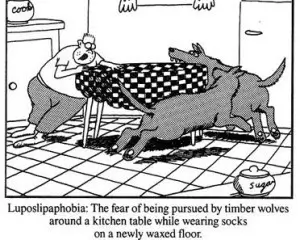
Larson took the traditional anthropomorphism of literature and cartooning and re-wilded it, taking it back from the cuteness that often afflicted human/animal hybrids. There is nothing cute about the animals or situations in which we find ourselves implicated. Luposlipaphobia is a classic example. We see a young boy getting chased by timber wolves around a kitchen table whilst wearing only socks on a just polished floor. We have no idea how the wolves have gotten into the kitchen and they are portrayed as purely wolf-like but somehow we know they know that the floor is waxed, the kid is shoe-less and dinner is very soon. It’s quite a domestic scene, and shows us a ‘tooth and claw’ (and socks) predator and prey situation. It seems very wild but very natural. One commentator points out:
“And then (the kid in the cartoon's) got that pinhead with a horrible haircut. If you look at 'Peanuts' cartoons, you've got these oversized round heads with widely spaced eyes that connote childhood, and innocence, and cuteness. This has lots of round shapes, but none of them connote cuteness. It's all about devolution and sedentary pursuits.” [4]
I would disagree about Peanuts being cute. As we explored in a previous essay in the last issue of the Honest Ulstermen there was decidedly nothing cute about the world Schulz created. However, the point that the kid is perhaps representative of the sedentary epidemic that was bothering the US consciousness towards the end of the 20th Century and would perhaps be a contributing factor to the obesity epidemic that haunts contemporary life in America today.
Soper in his analysis of this particular cartoon gives the kid a fighting chance contending that we don’t actually know if the wolves finally catch him as Larson rarely depicted the actual horror but more often the just-before-ness or the aftermath of situations. I wouldn’t be so certain as to a positive outcome for the kid. Soper’s correct in noting that Larson invites the reader to finish the cartoon. You can almost literally feel the panic. Perhaps the kid is symbolic of our helplessness in the face of the failure of the reality of ‘nature’ we have constructed and the realisation that we have no superiority over it and that we can’t hide from it in our kitchens and keep it outside. There’s a definite feel of a ‘dark ecology’ as we witness the predators and prey play out the inevitable. It’s only our constructs (metaphorical and actual) that keep us on top of the food chain. Take these away or (as Larson often does) add an intelligence to creatures and we quickly realise that our assumptions are built on sand:
‘Nature is a product behind a glass screen in a shop window. The glass screen is the windshield of your SUV. You drive your SUV through the wilderness to get a couch potato experience of watching Nature as if on TV. Or you watch TV shows of other people doing it, so you don’t have to. Nature is a combination of agricultural framing of the world with its rolling hills and horizons and sheep; and of industry, with its processes and automation. Nature is a modern product that is antiqued to look ancient and premodern. But modernity is over – the writing is on the wall, or rather in the thin layer of carbon deposited from 1790 throughout Earth’s crust, beginning what is now called the Anthropocene. We created a geological era that now intersects with human history: think for a moment about how scary that is. Now we know it – so Nature, which just is “stuff over yonder” – is no more, because we now know that “over yonder” doesn’t exist: it has a real name, such as Pacific Ocean or wastewater treatment plant or neonatal tissue. There is no “away” to which to chuck things anymore.’ [5]
We can see how Larson in this cartoon and Timothy Morton in the quote above are exploring the same concepts. We are not separate from nature. We cannot theme-park it and hope it behaves itself. We cannot make it human. The wolves are always at the door (or in this instance the kitchen). The Earth isn’t a mother. Or a she. It doesn’t care. If we aren’t careful it will devour us. If we name things we own them and even with the best intentions giving the earth a title of sex diminishes it and places it as the ‘other’ which we can protect or destroy because either explicitly in the case often of big businesses and corporations or perhaps unconsciously in the case of those that wish to protect or preserve the environment.
The Real Reason Dinosaurs Became Extinct
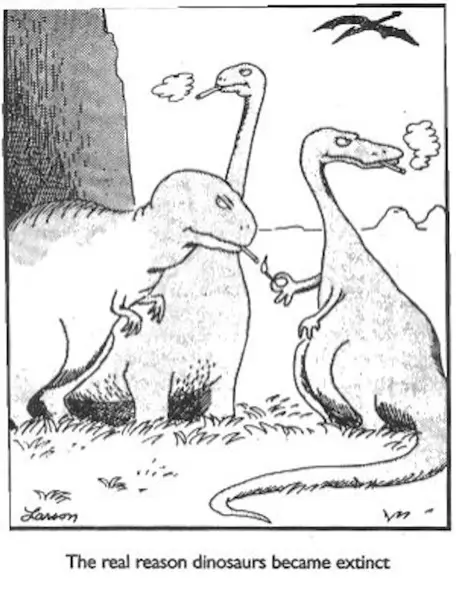
Great writing has a tendency to be able in a few lines to encapsulate various histories and contexts, even the most apocalyptic ones. Larson was able to do this cleverly. One of his most famous cartoons (above) depicts three dinosaurs reminiscent of school-kids smoking behind the bike sheds, one seemingly keeping a lookout in case anyone catches them. The six words are one of the most effective in literature: The real reason dinosaurs became extinct.
Of course, this cartoon is not about dinosaurs even if it about dinosaurs. It is about humanity’s massive capability for self-destruction. Though a few years later it could perhaps have been taken as a humourous take on internet hysteria and fake news. The dinosaurs are a very useful metaphor for the sudden disappearance of a species and how nature reminds us of our status. Larson tackles this again in another strip:
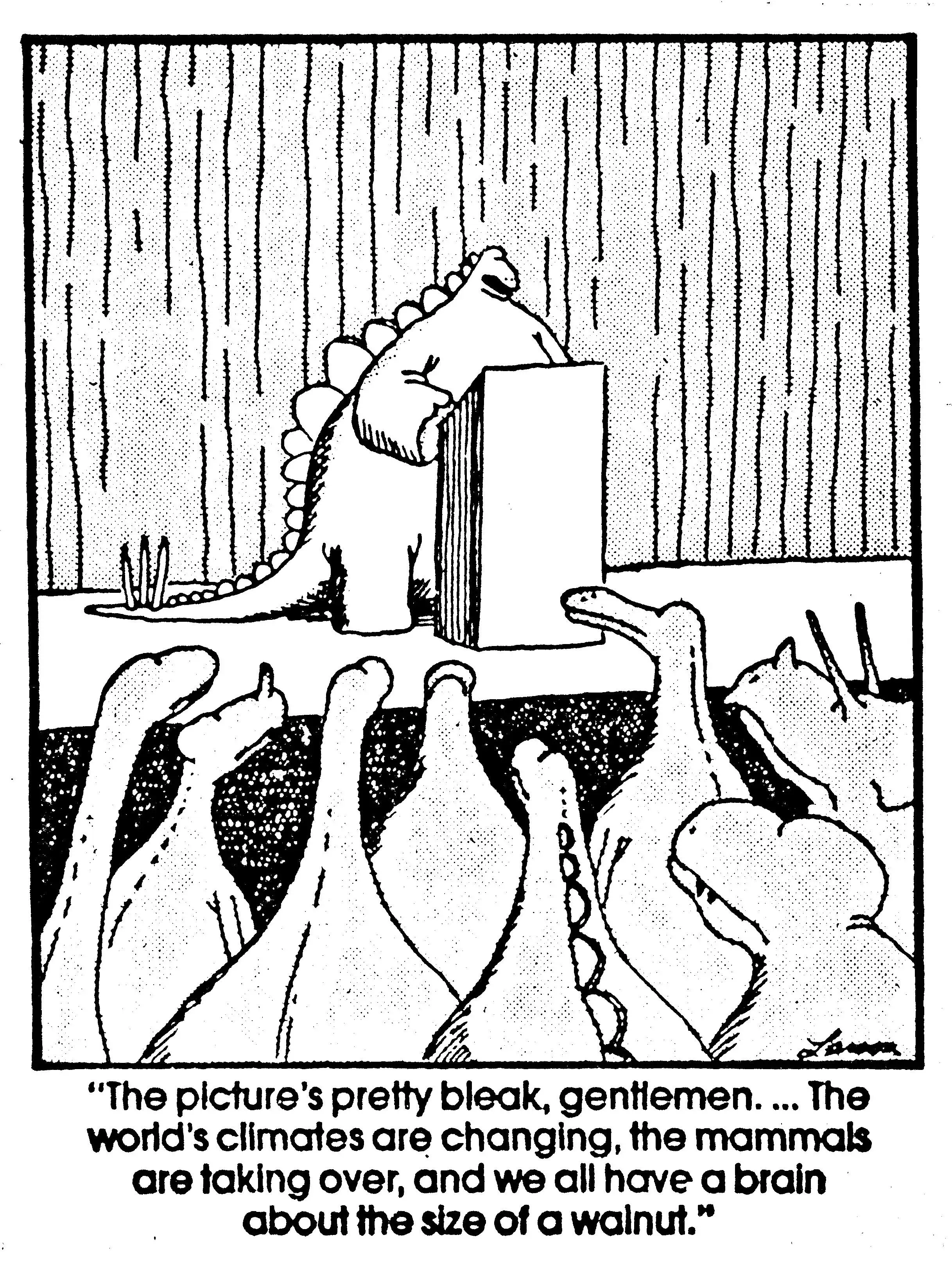
The fear that we are as a person, a community, a culture is in danger of collapse or being overwhelmed by ‘outside’ influence has been a stable of authors and populist politicians for centuries. We even have a ‘Doomsday Clock:
The Doomsday Clock is another touchstone of the geopolitical mood. A countdown to global catastrophe devised by scientists in 1947 in the wake of the nuclear bombings of Hiroshima and Nagasaki, it was conceived as an analogy for the threat of global nuclear war. The clock started at seven minutes to midnight, with midnight symbolising the end of life as we know it. The hands have been adjusted 22 times, fluctuating between two and 17 minutes to midnight. Since 2007, it has reflected global challenges more generally, encompassing climate change and artificial intelligence as well as nuclear war. [6]
We’re currently at two minutes to midnight and have been there for the last two years. This shouldn’t be considered as edging towards stability but rather walking on the edge. As the Bulletin of the Atomic Scientists points out:
this setting should be taken not as a sign of stability but as a stark warning to leaders and citizens around the world. The current international security situation—what we call the “new abnormal”—has extended over two years now. It’s a state as worrisome as the most dangerous times of the Cold War, a state that features an unpredictable and shifting landscape of simmering disputes that multiply the chances for major military conflict to erupt. [7]
The clock was initially envisaged as a warning against nuclear catastrophe but now covers various threats including global warming or climate change as it is now slightly less threateningly known these days. Of course, given the situation in the world political sphere and the rise of populism the seemingly diminished (after the end of The Cold War) threat of nuclear Armageddon is once again easily imaginable.
Larson was often on the side of the science and has a large following in the scientific community. Entomologists even paid tribute to him by naming a species of butterfly from the Ecuadorian rain forest the Serratoterga larsoni, and a species of chewing louse found only on owls the Strigiphilus garylarsoni after him. May Berenbaum, an entomologist at the University of Illinois comments:
''He covered an extraordinary diversity of insect biology, and he was usually dead on the mark. For example, insect fecundity -- the housefly with thousands of pictures of maggots in a billfold. Or cannibalism -- one female mantid saying to the other, 'How dare you insinuate I would eat your husband?' People are not accustomed to looking at things through compound eyes.'' [8]
Of course, scientists (or increasingly experts of any kind) are often villains in the populist mind and manifesto and appear regularly as the originators of apocalyptic viruses and the like in apocalyptic and post-apocalyptic literature. Experts are now portrayed as a part of the ‘establishment’ and in the age of conspiracy which we currently live in are either disbelieved or actively thought to have evil intentions:
… There’s nothing in the Bible that talks about vaccines. So, just want you guys to think about that. So if God knew in the future that He was gonna help create these amazing things that were gonna just change our health and be the best, you know, scientific advancement in human society ever, and it’s just, “Oh my gosh, they’re so great,” like, why isn’t there anything… any inkling of talk about these things called “vaccinations” coming into being later to save people?
Like, if that was really God’s plan, and they’re so amazing, then why isn’t it in there at all? [9]
The above is one extreme example, but faith is being used in opposition to scientific evidence, a battle more suited to pre-Enlightenment times than currently, as can been seen in the anti-vaccination battles currently being waged in the USA.
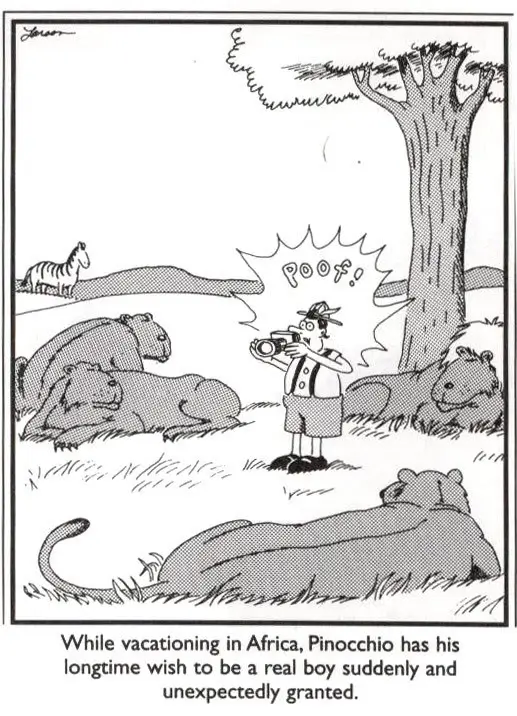
In uncertain times there is a tendency to look for the ‘reality’ behind the present and a distrust of the ‘fact’. As is noted in the John Callahan essay it is often a majority community that suddenly has to deal with societal and cultural change and a questioning of its preconceptions and traditions. In response there is a drawing in behind walls and an assumption that reality is being hidden. There are claims that people are now afraid to be ‘real’ and are now overwhelmed by political correctness. This is often a lament for a 'better time' when racism, sexism or homophobia could be displayed or articulated without consequence. ‘Reality’ of course often has unconsidered consequences as we see in Larson’s depiction of Pinocchio suddenly getting his wish fulfilled.
Our concepts of nature are of course based on our notions of self and difference. We are who we are because we are not them essentially. Especially in these (supposedly late) neo-liberalism days where the ideals of collectivism in the work-force and society generally have been binned. This is especially the case in those that perceive multiculturalism as anathema to their ‘traditions’ and way-of-life. There is now a battle over the nature of reality with the ‘real and ‘reality’ being very different things. ‘Connection’ is an important part of this. People want to believe that there was a better time. And they want to reconnect to it and are encouraged in this by the Right and by populists. Which means they want to disconnect to things, the things that make contemporary society different: new cultures, new lifestyles, the protection and celebration of minorities and the like. Timothy Morton makes an interesting point about this in a conversation with curator Hans Ulrich Obrist:
we’re all involved in this higher level sort of war about the nature of reality actually and how to care for it, all of us, not just philosophers: artists, people, cats, dogs, cities. And so yes, I think in a way it’s like the toolbox, although I suspect the toolbox is more an epistemological toolbox than an ontological toolbox; I’m actually saying, ‘Get this piece of plastic and connect it to this piece of leather, and then make this other thing that looks a bit like Kermit the Frog and then join that together with some group over here, and then let’s form this solidarity with these other life forms,’ and that kind of business. Where there’s less of an emphasis on getting the attitude right, you know? I think that’s maybe a hang over from the kind of postmodern… Not Foucault in particular, but just the general vibe of how it’s worked, even in the last 200 years, not just in postmodernism, the whole approach of art, like ‘If we just get the attitude right then everything will work,’ ‘If I just paint these cubes everything will come out alright,’ you know, ‘If I just think everything is a urinal everything will be good,’ you know? But everything isn’t a urinal. Everything is, like, a frog or a glass of milk or a saucepan or a TV or a staircase or Hans Ulrich, right? So you can’t just keep on tweaking your concept, you can’t say, ‘If I open the refrigerator correctly I will see the light in the best possible way,’ it’s like by the time you get there the fridge already melted all the ice cream. And it’s the same with the Earth, it’s like by the time you get the attitude right of why to save it and what it is, it’s already gone, so we’re in this position where there’s a kind of immediacy where we’re making these things, but that doesn’t mean, ‘Just do it,’ in this kind of anti-intellectual, Proto-fascist way, it’s more like as you make these toys you’re more like, ‘Wow, this is not my beautiful toy, this is not my beautiful biosphere.’ [10]
This lack of connection and desire to reconnect to some imagined Utopian or golden time echoes back to the ‘Fall of Man’ (from the Garden of Eden in biblical iconography) and it isn’t coincidental that often those wanting to reconnect are members of particularly conservative faiths. We can’t of course go back home again so to speak. Larson was particularly aware of this and made the point in numerous cartoons particularly those featuring cavemen (and women):

We see a Neanderthal couple at a restaurant. While the male is desperately trying to rub two sticks together the new culture (or in this case, possibly species) approaches the female and lights her cigarette. This harks back to the fear that we will somehow lose our wives and daughters (as if they were possessions) to more ‘advanced’ people which will ultimately lead to sexual deprivation and a lonely death. This is part of what academics called Terror Management Theory:
Terror management theory (TMT) attempts to explain a type of defensive human thinking and behavior that stems from an awareness and fear of death. According to TMT, death anxiety drives people to adopt worldviews that protect their sense of self-esteem, worthiness, and sustainability and allow them to believe that they play an important role in a meaningful world. Human survival instincts, and the need to reinforce cultural significance in the face of death, often result in displays of prejudice, or the belief that the group with which one identifies is superior to other groups. In this way, people confirm their self-importance and insulate themselves from their deep fear of merely living an insignificant life permanently eradicated by death. TMT proposes that individuals are motivated to develop close relationships within their own cultural group in order to feel immortal, to convince themselves that they will somehow live on—if only symbolically—after their inevitable death. [11]
Larson through his Far Side years is especially brilliant at humorously portraying this fear of extinction. Of course, sometimes in the Far Side there’s an upside to humanity’s end. In one strip we witness an insect party as nuclear bombs explode in nearly cities:

The classic joke being of course that it’s only cockroaches and other insects that will survive a nuclear war. Larson continually mocks our anthropocentric tendencies and explicit specism. Nature itself as a term is brimful of racist tendencies and assumptions asserts Morton:
Nature is a thing that is supposed to be “over there” somewhere. It’s in my DNA, it’s under the concrete, it’s “over yonder” in the mountains and stuff. Now we know that there’s no “away.” When you flush the toilet, whatever’s in there doesn’t go to some magical place called “away.” It goes into the ocean or into the wastewater treatment plant. If there’s no “away” then there’s no Nature. Nature is just a stage set created by anthropocentrism so we can feel different from non-humans. I like to capitalize the word to remind myself that it’s an artificial construct. In short, given what I said before, Nature is a racist concept. [12]
This essay has placed Gary Larson and the Far Side in a ‘dark ecology’ concept in which the barriers between our artificial concepts and constructs of ‘Nature’ are swept aside and we realise that the distance between us and non-human ‘things’ is slight or even non-existent. Some major names in the science world have recognised this:
The American biologist and naturalist Edward O. Wilson describes Larson as “the madcap sage of the biological sciences” and credits the cartoonist with an important insight: “Nature is part of us and we are part of Nature” (Foreword to Larson’s “There’s a Hair in My Dirt: A Worm’s Story”). Primatologist Jane Goodall agrees, suggesting, “Gary’s cartoons help us to see things with a new perspective, above all to realize that we humans, after all, are just one species among many, just one small part of the wondrous animal kingdom”. [13]
Larson allows our assumption in regard to our place in the world and our interaction with its non-human inhabitants to be critiqued and questioned facilitating perhaps an epiphany in human consciousness...

In this essay and the three preceding it I have taken some of the concepts that have driven the Abridged magazine throughout the years and applied them to four of the leading cartoonists of the mid/late 20th Century. I do consider cartoons to be literature as much as people consider poetry or stories with illustration to be. The time to be creating walls between artistic disciplines has (hopefully) passed, even if it seems more walls are being constructed in the real world. I’m uncomfortably aware that the four cartoonists whose work I chose to examine are all male. The mainstream cartoon world of the twentieth century was a very male and overtly sexist environment and these were the ones that I was exposed to and therefore identified with first and foremost. Future essays will I hope restore a bit of balance and feature female cartoonists that have been deliberately overlooked and as a consequence in the main forgotten by contemporary readers.
The opportunity to write these essays would not have been possible without the assistance of the Arts Council of Northern Ireland through its excellent Support for the Individual Artist funding scheme and I am very grateful for their help.
[1] http://badatsports.com/2012/the-borders-of-society-an-interview-with-timothy-morton/
[2] https://www.independent.co.uk/news/people/profiles/the-far-side-of-gary-larson-743135.html
[3] http://mentalfloss.com/article/88286/11-twisted-facts-about-far-side
[4] https://www.deseretnews.com/article/900032281/the-far-side-was-a-weird-comic-this-byu-professor-helped-us-translate-it.html
[5] http://badatsports.com/2012/the-borders-of-society-an-interview-with-timothy-morton/
[6] https://www.economist.com/prospero/2017/04/12/charting-trends-in-apocalyptic-and-post-apocalyptic-fiction
[7] https://thebulletin.org/doomsday-clock/current-time/
[8] https://www.nytimes.com/1998/04/28/science/aficionado-of-science-gary-larson-an-amateur-of-biology-returns-to-his-easel.html
[9] https://www.patheos.com/blogs/progressivesecularhumanist/2018/04/christian-author-warns-vaccines-are-satanic/
[10] http://dismagazine.com/disillusioned/discussion-disillusioned/68280/hans-ulrich-obrist-timothy-morton/
[11] https://www.psychologytoday.com/gb/blog/out-the-darkness/201801/the-psychology-racism
[12] https://washmagazine.com/Interview-Timothy-Morton
[13] Foreword to Larson’s “The Far Side Gallery 5

Dr. Gregory McCartney is the editor of Abridged, the HU and an independent curator.
More work by Greg McCartney



Tel: 028 7126 6946
Email: hueditor@theverbal.co
Verbal, Stable Lane and Mall Wall, Bishop Street Within, Derry/Londonderry, BT48 6PU
 company
Copyright © 2026 Honest Ulsterman