

Kingdoms of Gravity
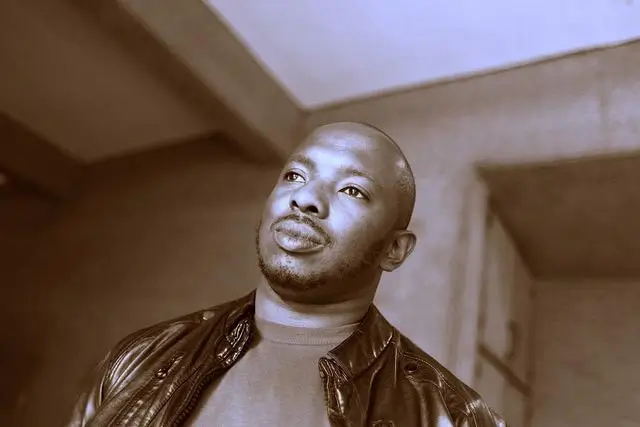
Nick Makoha was shortlisted for the 2017 Felix Dennis Prize for Best First Collection for his debut Kingdom of Gravity. He is a Cave Canem Graduate Fellow and Complete Works Alumni. He won the 2015 Brunel International African Poetry prize and was the 2016 winner of the Toi Derricotte & Cornelius Eady Chapbook Prize for his pamphlet Resurrection Man. His poems have appeared in The New York Times, Poetry Review, Rialto, Poetry London, Triquarterly Review, Boston Review, Callaloo, and Wasafiri. He is a Creative Entrepreneur-in-Residence at Goldsmiths working to create an in depth online digital archive of the Metic experiences of Black British Writers. Find him at www.nickmakoha.com
Nick Makoha’s first full-length collection, Kingdom of Gravity (Peepal Tree £8.99), was the 2017 debut which most excited me. Focused on Uganda during the Idi Amin dictatorship, his poetry is charged with ethical sensibility. The lines protest as they sing “the song disturbed by helicopter blades…” but they don’t simplify things: they explore, and complicate. Personal witness and artistry are one. - Carol Rumens - The Guardian
Greg McCartney: Hi Nick, thanks for being in the HU. You had a tumultuous childhood. Your mother and yourself left Uganda after the coup that brought the infamous Idi Amin to power. How much of that flight do you recall? I imagine 1970s Britain being a shock to the system. It is something perhaps psychologically difficult to recover from?
Nick Makoha: The flight to London Heathrow is fragmented in my mind. It was the first flight I had ever taken. I think my mother feels the impact more than me. Much of who she is was formed in Uganda. Her courage has given me a life in a new world. She tried to make our departure from Uganda as normal as possible. I was not aware I would not return to my home country or that I was leaving my father and his family behind. The shock comes much later when you are older and your body and spirit feel the weight of what has been left behind or forgotten.
GMCC: How did you come to poetry? Was it a part of your childhood and family life? Did you grow up in a literary household?
NM: I wrote my first poem when I was six years old at primary school. I was always writing on whatever I could find but I did not call it poetry until that point. Looking back poetry has always been close at hand. It was the space in which I could be myself without feeling less than. Letting go of your homeland does something to you as does having to embrace a new culture where you stand out for all the wrong reasons or more accurately for reason you do not understand. I am not aware of other writers in my family before me. My mother and father read to me as a child. I was a bookworm and often read beyond my years.
GMCC: Kingdom of Gravity, your latest collection deals with post-colonial Africa and Uganda in particular and your relationship with it past and present. I read in an interview that you mentioned you were a bit ashamed in avoiding ‘your story’. Was there a need in you to explore that which you left perhaps critique the conditions that led you you fleeing? Maybe to fill in so to speak piece of yourself that you felt were missing? ‘Sad is the man who is asked for a story/and can’t come up with one’ as you say in your CDG poem.
NM: I am proud to be from Uganda. But in order to come to the mental space I needed to be in to write Kingdom Of Gravity I had to come to terms with my invisible shame. The loss of my mother tongues, the absences of sufficient memories and a certain sense of detachment that comes with that. The book demanded a quiet sensitivity to deal with the story of Uganda without the political, social and tribal biases that can often invade the narrative. The journey of writing this book opened me up to a Uganda that is not made present to the Western world.
GMCC: I really like the line in At Gun Point: ‘In this cracked republic/I have made a film of my life and played myself.’ For me it suggests the acknowledgement perhaps of the difficulty of poetically putting yourself into a culture that you’re no longer everyday involved with and that those referenced in the poem are also playing roles in a ‘failed colonial experiment’. Living as you are now in London did you find it difficult to go back to so to speak these parts of your life? How much is the work a commentary on contemporary Uganda than it is your and your family’s experience of it?
NM: I only found the subject matter difficult at the beginning. The world I live in now has limited understanding of country I was born into. The story of my country is often obscured by politics and rhetoric and other devices, that distract the heart and mind from the human elements. That can make it hard to feel connected to the country of your origin. I needed to find the people of Uganda. Once I found their story I knew that my story would fit into the jigsaw.
GMCC: I remember having a conversation with George Shaw the painter, who told me he considered each painting in one of his exhibitions like a track from an LP. I got the similar feeling from reading Kingdom of Gravity not only because of the lyricism of the work but how it all fits so well together. What was the process of putting the book together?
NM: The unit of the poem is the line. So I work line by line until I have a poem. Usually this first draft is left to marinate. Once I have enough poems at first draft stage a concept shows itself. I do like the concept of the LP. I used to spend hours reading the album sleeves of my mother’s records (Steve Wonder comes to mind). As a child I would often make mixtapes from music of the radio, trying as hard as I could to match rhythms, styles and lyrics. The ear, hand and the eye have to have synergy. Even the silence has purpose on a mixtape. I know at some point in the writing of my poems the mutate to scores of music. I guest Kingdom of Gravity is a mixtape of Uganda in the 1970’s.
GMCC: Ireland has a long history of literature dealing with emigration. I love that line from Citizen: ‘The airport is my changing room’. The imagery of putting on new clothes/a new self for a new country is very powerful. Inevitably new things come with a cost. Is it possible (stretching a metaphor) to get your old clothes back? Perhaps the power of the poet is that they can imagine other alternative universes and what-might-have-beens?
NM: I am not a historian I am a poet. But as you put it “A new self for a new country.” describes what I call the Metic Experience, the act of being a resident alien. At birth I was one self a Ugandan from Uganda. But the moment I arrived on these shores a new self emerged. The Metic has to negotiate theses realms or selves pf existence. The aim is therefore not to get the self back but to be aware that both exist and are at your disposal.
GMCC: I ask a version of this to everyone I interview but I am also fascinated by the different answers that people come up with. What is the role of the poet today, in our ‘post-truth’ society?
NM: The role of the poet is to live life and create art. Our tool is language just as a musician’s tool is sound. We are not here to tell people how to live their lives but rather to show that people have lived.
GMC: How did you find writing a theatre piece as opposed to poetry?
NM: I enjoy writing theatre. My instincts are naturally honed to write poems so there has been a learning curve. Theatre demands a different way of listening. Both forms throw light on the notion of story and storytelling.
GMCC: You also work with young people and have set up youth poetry projects. Do you see that perhaps sense of social engagement as integral to being a contemporary poet?
NM: I think social engagement is integral to being a human being. I always question people or groups that do not have young people in mind.
GMCC: What poets are you reading at the moment?
NM: I just saw Notes from the Field at the Royal Court Theatre by Anna Deavere Smith. So I have pulled out some of her work to read. I am also reading We the Animals by Justin Torres and Ordinary Beast by Nicole Sealey.
GMCC: What are your plans for the future?
NM: I am currently on a national tour of my book Kingdom Of Gravity as part of Mixtape tour with my friend and colleague Roger Robinson. His book Portable Paradise will be out soon. I have been invited to be one of the editors of Breakbeats Internationally Known. It will be the 5th instalment of the Breakbeat Poets series on Haymarket books. I will be working alongside Kevin Coval and Safia Elhillo. I am also working with Fuel theatre and director Roy Alexander Weise on a new play called The Dark. We are currently in rehearsals. The play is based on how my mother and I left Uganda in the 70’s. I have been invited to the Ake Literature Festival in Nigeria. Other things are in the pipeline but not confirmed.
GMCC: Thanks again for being in the HU!
You can buy Kingdom of Gravity here: http://www.peepaltreepress.com/books/kingdom-gravity

Dr. Gregory McCartney is the editor of Abridged, the HU and an independent curator.
More work by Greg McCartney


Tel: 028 7126 6946
Email: hueditor@theverbal.co
Verbal, Stable Lane and Mall Wall, Bishop Street Within, Derry/Londonderry, BT48 6PU
 company
Copyright © 2026 Honest Ulsterman