


Posted in: February 2019 Edition
It's not denial. I'm just selective about the reality I accept.
Greg McCartneyCalvin and Hobbes and Perception
These essays were supported by the Arts Council of Northern Ireland's Support for the Individual Artist Scheme and to whom I owe my gratitude. Essays on the Far Side and Callahan will appear in the June issue.
‘Calvin and Hobbes’ is very well known and at the same time, mainly because of the comparative reclusiveness of its creator, Bill Watterson and his complete aversion to turning the strip into products other than a book it still has somewhat of an air of mystery about it:
Calvin and Hobbes follows the adventures of the mischievous boy Calvin and his best friend Hobbes, a tiger who may or may not actually exist. Their relationship is by turns playful, combative, thoughtful and fantastical; they act and sound like real best friends. But they do things that most kids can only dream of – they time travel, dig for dinosaur bones in the backyard and build legions of abominable snowmen. Sometimes Watterson sketched out memorable parables that drove their point home with a chuckle (often at Calvin's unwitting expense) and at other times he gave readers straight-up gags, explored family dynamics or sent his intrepid duo hurtling through time and space and over cliffs. No matter what magic Watterson concocted, there was rarely a moment when the strip felt forced or, worse yet, meaningless. [1]
Watterston took his art very seriously and fought numerous battles against the product placement people:
As he once wrote in the introduction to a Krazy Kat collection, "[W]e seem to have forgotten that a comic strip can be something more than a launch pad for a glut of derivative products. When the comic strip is not exploited, the medium can be a vehicle for beautiful artwork and serious, intelligent expression." So, instead of embracing the fame his work afforded him over the years, he gave only a handful of interviews, rarely appeared in public and maintained a very modest lifestyle. He was equally withholding of his creations, whom he never allowed to be merchandised. There were no Hobbes dolls, no Spaceman Spiff action figures and no coffee mugs with Calvin and Hobbes one-liners splashed across them. Considering that all his peers were cashing in on their creations – Charles Schulz (Peanuts) and Jim Davis (Garfield) each earned tens of millions of dollars a year at the height of their fame – it was a tack that was as admirable as it was confounding. [2]
Peanuts inevitably was a huge influence on contemporary cartoonists. Bill Watterson’s Calvin and Hobbes stripped down Schulz’s world even further focusing on a little boy (Calvin) and his best friend, a cuddly tiger. Calvin was named after the rather gloomy theologian John Calvin who was hugely influential in making many religious people miserable particularly those of a creative bent. The Bronte’s, in particular Anne, springs to mind. Predestination essentially boiled down to a few are the elect of God and the rest of us are damned. Watterson’s little boy as he pointed out isn’t based particularly on his childhood self but rather the pieces of himself and human nature that he isn’t particular proud or impressed of:
Calvin is autobiographical in the sense that he thinks about the same issues that I do, but in this, Calvin reflects my adulthood more than my childhood. Many of Calvin’s struggles are metaphors for my own. I suspect that most of us get old without growing up, and that inside every adult (sometimes not very far inside) is a bratty kid who wants everything his own way. I use Calvin as an outlet for my immaturity, as a way to keep myself curious about the natural world, as a way to ridicule my own obsessions, and as a way to comment on human nature. I wouldn’t want Calvin in my house, but on paper, he helps me sort through my life and understand it. [3]
Hobbes the tiger is named after another gloomy philosopher, Thomas Hobbes, who believed that power only leads to the desire for more power, and figured that only a Leviathan, that is, a chosen oligarchy/monarch, is the solution to the ills of society. Interestingly Watterson doesn’t see Hobbes as Calvin’s ‘imaginary friend’ or as a mannequin that somehow comes to life when only Calvin is around:
The so-called “gimmick” of my strip—the two versions of Hobbes—is sometimes misunderstood. I don’t think of Hobbes as a doll that miraculously comes to life when Calvin’s around. Neither do I think of Hobbes as the product of Calvin’s imagination. Calvin sees Hobbes one way, and everyone else sees Hobbes another way. I show two versions of reality, and each makes complete sense to the participant who sees it. I think that’s how life works. None of us sees the world exactly the same way, and I just draw that literally in the strip. Hobbes is more about the subjective nature of reality than about dolls coming to life. [4]
Whilst Peanuts created quite a cruel world populated by only children Watterson set Calvin and Hobbes set in an ‘ordinary’ family figuring out how to bring up a child and at times struggling with it. Calvin’s (unnamed) father is party based on himself and his father:
I’ve never given Calvin’s parents names, because as far as the strip is concerned, they are important only as Calvin’s mom and dad. Calvin’s dad has been rumored to be a self-portrait. All my characters are half me, so it’s true in some ways, but Calvin’s dad is also partly a satire of my own father. Any strip about how suffering “builds character” is usually a verbatim transcript of my dad’s explanations for why we were all freezing, exhausted, hungry, and lost on camping trips. These things are a lot funnier after twenty-five years have passed. [5]
Calvin is not an easy kid to love and Watterson’s sympathy is with the mother whom we usually generally see suspicious, angry or exasperated or all three:
Calvin’s mom is the daily disciplinarian, a job that taxes her sanity, so I don’t think we get to see her at her best. I regret that the strip mostly shows her impatient side, but I try to hint at other aspects of her personality and her interests by what she’s doing when Calvin barges in. . . We usually only see Calvin’s parents when they’re reacting to Calvin, so as secondary characters, I’ve tried to keep Calvin’s parents realistic, with a reasonable sense of humor about having a kid like Calvin. I think they do a better job than I would. [6]
Calvin and Hobbes would also expand on Snoopy’s dreamworlds to explore the nature of reality and suggest that we create our own conceptions of ‘reality’ and what is real. Hobbes is often considered as an imaginary friend but as Watterson points out it’s not usually the case that imaginary friends actively disagree and indeed argue with the so-to-speak imagineer. Hobbes can be seen rather as the capacity to imagine other worlds and alternative universes. This extends Peanuts use of the imaginary. Whereas only Snoopy abandons the reality of his ‘doghood’ and his dependence on Charlie Brown and retreats into the past for instance WW1 or pretends he is a barrister or writer, in Calvin and Hobbes the two main characters go to different worlds filled with monsters and spaceships. Waterson is a big fan of Peanuts, if not the grand commercialisation that has somewhat overwhelmed its greatness:
Peanuts is long overdue for a serious reappraisal. Its ubiquitous licensing program unfortunately obscures what a well-crafted, beautifully written and drawn strip it is. Peanuts is one of the very rare strips with true heart. The sophistication and subtlety of the work is unbelievable. Comics don’t come better than this. [7]
Peanuts’ genius is that it has a bunch of kids living out adult agonies and cruelties and rejection in a coherent world in which the characters are still clearly children with their own individual characteristics and not merely conduits for adult concerns. It is however very much of this world. Watterson offers us the child’s view of reality populated by talking tigers and actual monsters-under-the-bed and the adult world in which camping trips which no-body really enjoys somehow build character and asks which is really the real world?
Comic-strips are often seen as ephemeral things that don’t particularly concentrate on character development and complex storylines. Watterson as we have already indicated famously took his work so seriously that he refused to licence it feeling that it would demean his writing and drawing:
Calvin and Hobbes isn’t a gag strip. It has a punch line, but the strip is about more than that. The humour is situational, and often episodic. It relies on conversation, and the development of personalities and relationships. These aren’t concerns you can wrap up neatly in a clever little saying for people to send each other or to hang up on their walls. To explore character, you need lots of time and space. Note pads and coffee mugs just aren’t appropriate vehicles for what I’m trying to do here. I’m not interested in removing all the subtlety from my work to condense it for a product. [8]
Bill Watterson was born on July 5, 1958, in Washington, D.C. When he was 6 years old, he moved with his father James, a patent attorney (which would be the job given to Calvin’s father), and his mother, Kathryn, to Chagrin Falls, Ohio. After the family settled in, Kathryn became involved in local city administration. James Watterson would also serve on the Chagrin Falls city council, but not until some 30 years later. Coincidentally Schulz’s father would also serve in local government. Watterson, unlike his most famous creation Calvin, was a quiet child who didn’t cause his parents much trouble and didn’t reasonably well in class. He describes his childhood quite humorously though with a hit of the surreal and shifting concepts of ‘nature’:
I grew up in Chagrin Falls, which is a small town, an outer suburb of Cleveland. It was originally a mill town in the 1800s, and a paper-bag factory was still going when I was growing up. They used to dump their dyes right in the river, so as a kid I remember seeing the river turn red and so on, if you can believe it. The town is fairly upscale now, but back then maybe a little less so. There was a hobby shop, a stationery store, three little drugstores, two hardware stores, and so on. Small local businesses where you could get pretty much anything you’d need without driving somewhere else. The Main Street bridge goes over a big natural waterfall, and Victorian buildings surround the town triangle, which has a bandstand in the middle of it. It’s one of these quintessentially American towns that dot Ohio. Very Normal Rockwell – all white, very Republican. I had a sheltered childhood. [9]
Similarly to Schulz, Watterson would spend lots of time drawing both at home and in school where he would draw for class and school publications. In the mid-1970s he enrolled in his local college and studied drawing and he drew for its newspaper 'The Kenyon Collegian'. Graduating with a degree in political science, he was immediately hired by The Cincinnatti Post as a political cartoonist. Though knowledgeable about the subject matter but not local politics, (he’d lived there about a fortnight) which was what the Editor required of him, he soon found himself back on the dole queue. Essentially the Editor wanted another version of the acclaimed cartoonist Jim Borgman and wanted one immediately. Weirdly as it happens Watterson knew was inspired by Borgman:
Borgman graduated from Kenyon Collage the year before I went there, and it was his example that inspired me to pursue political cartooning. He had drawn cartoons at Kenyon, and landed his job at the Cincinnati Enquirer right after graduation. His footsteps seemed like good ones to follow, so I cultivated an interest in politics, and Borgman helped me a lot in learning how to construct an editorial cartoon. Neither of us dreamed I'd end up in the same town on the opposite paper. I don't know to what extent the comparison played a role in my editor's not liking my work, but I was very intimidated by working on a major city paper and I didn't feel free to experiment, really, or to travel down my own path. I very early caught on that the editor had something specific in mind that he was looking for, and I tried to accommodate him in order to get published. His idea was that he was going to publish only my very best work so that I wouldn't embarrass the newspaper while I learned the ropes. As sound as that idea may be from the management standpoint, it was disastrous for me because I was only getting a couple cartoons a week printed. I would turn out rough idea after rough idea, and he would veto eighty percent of them. As a result I lost all my self-confidence, and his intervention was really unhealthy, I think, as far as letting me experiment and make mistakes, and become a stronger cartoonist for it. Obviously, if he wanted a more experienced cartoonist, he shouldn't have hired a kid just out of college. I pretty much prostituted myself for six months but I couldn't please him, so he sent me packing. [10]
It's interesting to note that the room to develop and to make ‘mistakes’ creatively is vital for a writer or artist of any sort but in our current climate of using the arts instrumentally and wanting particular results at particular times it is still often difficult for artistic development whilst trying to earn a living.
It did force Watterson however to rethink his commitment to political cartooning which requires a dedication to the subject added to often a sense of outrage or anger on a particular issue which he admitted he didn’t really have. He therefore spent his unemployment developing other characters two of which were Calvin and Hobbes though they weren’t the main characters of the strips he sent in hope to the syndicates for potential publication, Calvin was a little brother character and Hobbes was a stuffed tiger that came to life in Calvin’s imagination. Someone in United Features saw the potential of these two characters and suggested that they be the main focus of the strip though they still turned in down despite the fact that Watterson had a development contract with them. It seems they weren’t convinced by its marketability. Indeed the artist would comment later that he was offered publication if he included a ‘robot’ character which could be marketed to children. Here we see the first indications of his antipathy to the commercialisation of his ‘art’ in his refusal to countenance such a strategy:
Not knowing if Calvin and Hobbes would ever go anywhere, it was difficult to turn down another chance at syndication. But I really recoiled at the idea of drawing somebody else's character. It's cartooning by committee, and I have a moral problem with that. It's not art then. [11]
Literature (however it is defined) has always been about either ignoring preconceived concepts of reality or using a logic internal to the work that creates its own versions of reality. Add a bit of faith to the mix and we’re ready to believe the most ridiculous and contradictory stories from the Bible and other religious texts. Does anybody complain when a bear suddenly appears in Shakespeare’s The Winter’s Tale and chases Antigonus off-stage (and maybe even eats him)? To be fair he was going to kill an infant so probably deserves to be eaten but Shakespeare has no qualms about sudden and quite surreal shifts in the tale:
"Antigonus
exits, pursued by a bear"
-- The Winter's Tale, Act III Scene iii, Line 58
We’re fine with ghosts in Hamlet and witches in Macbeth and you’d imagine Shakespeare would have been perfectly OK with a child and an adult seeing a stuffed toy tiger in very different realities. Yet we often ascribe to ‘genre’ books with ghosts and witches in them now and often we don’t see cartoon strips as either literature or art at all. ‘Literature’ with a capital L always has a contradictory attitude to alternate realities. Some are fine, Alice’s adventures for example or quite posh kids in Narnia whereas many fine SF/Fantasy stories are not solely because some wealthy upper-class people (or more accurately men) decided they weren't worthy of the literary moniker and handed down this view to generations of (mostly non -posh) school children by corrupting the school curricula with their staidness.
As in the Peanuts essay, I’m not going to go into a long diatribe as to what is or is not literature but rather explore the nature of reality in the universe(s) Calvin and Hobbes inhabit. The important thing to remember is that within the covers of a book reality can be anything an author wants it to be. The good ones will have a world that has perhaps a consistency of crazy purpose and the even better ones might even abandon this and still convey a sense of weird logic of character and action. As Watterson points out:
When Hobbes is a stuffed toy in one panel and alive in the next, I'm juxtaposing the "grown-up" version of reality with Calvin's version, and inviting the reader to decide which is truer. Most of the time, the strip is drawn simply from Calvin's perspective, and Hobbes is as real as anyone. So when Calvin is careening down the hillside, I don't feel compelled to insert reminders that Hobbes is a stuffed toy. I try to get the reader completely swept up into Calvin's world by ignoring adult perspective. Hobbes, therefore, isn't just a cute gimmick. I'm not making the strip revolve around the transformation. The viewpoint of the strip fluctuates, and this allows Hobbes to be a "real" character. [12]
We don’t think to ourselves ‘wow’ this is an amazing talking stuffed tiger, we are caught up in the dynamic of Calvin’s reality in which Hobbes is a real living being, (which is something the best writers, artists, film-makers manage) and we accompany them on their adventuring without thinking ‘hang on a little boy or a tiger stuffed or not wouldn’t do that or this’. It is the combination of writing, art and space that facilitates this. One of the mistakes that Directors using CGI in films have perhaps realised is that using the latest CGI techniques on their own without a good story sometimes look less convincing than Ray Harryhausen’s dancing skeletons. We buy into a good story whether it’s a thousand pages long or three or four panels on a page.
Calvin has no problem with a stuffed toy tiger being animate and intelligent and neither should we as we’re buying into his reality as much as we do with Hamlet, his ghosts and Shakespeare’s manic endings. Watterson’s universe though questioning the nature of how we see reality was a pretty consistent environment with all the major characters appearing in the first three weeks of it’s public birth and no significant others added afterwards.
In 2012 I curated Tulca, a visual arts festival in Galway and gave it the title: ‘What Became of the People We Used To Be?’. People of a certain vintage and fans of classic BBC TV will recognise it as a lyric from the theme of ‘Whatever Happened to The Likely Lads?’ a comedy starring Rodney Bewes and James Bolam as two friends with very different attitudes to and conceptions of 1970s reality. Bewes played Bob, determined to be a professional/executive with attendant wife, house and car whilst Terry was a workshy former soldier who rather mocked his friend for ‘conforming’ but was possibly even more lonely than Bob’s terror of non-conformance to society’s goals. I loosely attached these different viewings of reality to the quantum many worlds/multi universe concept that has it that (theoretically) there are many different versions of me writing this (and probably very much explaining it better) and many different versions of you reading it. I was of course taking huge liberties of assumption without any direct evidence that any other worlds or realities actually existed. The Many Worlds’ theory has controversially evolved (and to be fair without quantifiable evidence) from ‘the wave function’ in quantum:
The wave function is a mathematical expression that defines all possible observable states of a quantum system, such as the various possible locations of a particle. Up until a measurement is made and the wave function collapses (whatever that means), there is no reason to attribute any greater a degree of reality to any of the possible states than to any other. It’s not that the quantum system is actually in one or other of these states but we don’t know which; we can confidently say that it is not in any one of these states, but is properly described by the wave function itself, which in some sense “permits” them all as observational outcomes. Where, then, do they all go, bar one, when the wave function collapses? [13]
The answer proposed was that the Universe is a kind of giant wave function contains ALL possible realities except we can only of course experience the one we inhabit though that too of course as produced argument and counter argument as to its veracity. I have no idea if there are many worlds or universes but the theory is useful as a tool to explore who we see and articulate reality and importantly what we take away from great books or artworks. As Watterson observed:
The only part I understand is what went into the creation of the strip. What readers take away from it is up to them. Once the strip is published, readers bring their own experiences to it, and the work takes on a life of its own. Everyone responds differently to different parts. [14]
He is probably being slightly glib as an author/artist/musician/etc in the main can’t abnegate complete responsibility as to how their work is perceived just as they can’t be held responsible for every reaction to it despite what right-wing politicians would make you think. Comics were a ‘danger’ to the American way of life well before ‘Rock n’ Roll’ then video games were a threat to US society. Like Schulz, he also isn’t keen on comics being a legitimate academic subject maintaining that if a comic has to be explained there must be something seriously wrong with it though he somewhat contradicted this in that he read Peanuts differently as a child (where he took it at face value) and later as an adult where is saw it all it is complexity of character and simplicity in use of space.
The writing pushed the art in Calvin and Hobbes to weird and fantastic worlds which were often far more complexly drawn than the actual ‘real’ world Calvin inhabited suggesting for Calvin this ‘fantasy’ world was much more real that they everyday one:
One of the jokes I really like is that the fantasies are drawn more realistically than reality, since that says a lot about what’s going on in Calvin’s head. So that, and my interest in creating a lively sense of animation, forced me to push the flatter, more cartoony and loose designs I started with into a more three-dimensional conception of form and space. If I wanted to draw Calvin from some odd camera angle, I had to visualize him sort of sculpturally, so I could draw it. That’s when you discover that the zigzag shorthand for his hair doesn’t work in perspective very well. Or you find that his tiny little legs are hard to make run, because he hardly has knees. You invent solutions to these sorts of problems, and that gradually changes the appearance of the strip. [15]
As we have touched on above, Calvin was not strictly a childhood version of the author:
Hobbes might be a little closer to me in terms of personality, with Calvin being more energetic, brash, always looking for life on the edge. He lives entirely in the present, and whatever he can do to make that moment more exciting he'll just let fly...and I'm really not like that at all. [16]
Children’s literature of the 1980s (unless you had knowledgeable parents or teachers that really knew their stuff) was still mired in ‘classics’ mixed with Enid Blyton perennials added to a mix of TV adaptions. There was little inspiration and even less subversion. Comics and comic strips were where the risk-takers lived, the writers and artists that offered children genuine thrills and scares often to the displeasure of their publishers who preferred safety and tradition.
As was indicated in the Peanuts essay comic-strips were a traditional part of the US newspaper experience and there was a time in the early Twentieth Century particularly that cartoonists were the equivalent of Rock Stars earning comparative fortunes. Inevitably publishers wanted versions of past successes and it was only the success of Peanuts that perhaps opened the door a bit for those that wanted to do something slightly different but even then it was a hard slog.
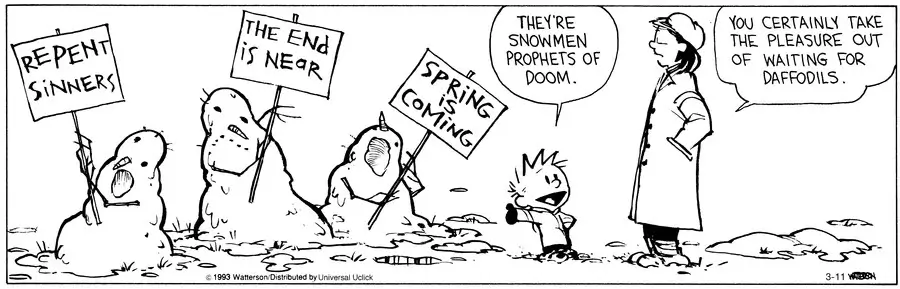
Calvin was definitely not the most wholesome of children and for a little kid he has a long long list of grudges and would use the generally wholesome activity of snowman making to seek revenge on his enemies:
Many times, Calvin is seen building snowmen only a few inches tall. He says that the small snowmen are his enemies in his real life and he enjoys seeing them melt. The first time the tiny snowmen were seen, he crushed them all while pretending to be a T-rex. On 2/29 1992, a group of a hundred strong tiny snowmen were running from a regular-sized snowman which, to them, was terrifyingly large. On 1/13 1993, fifteen or so snowmen were built at the bottom of a hill so that Calvin could crash into them with his toboggan. On 1/12 1995, a large gathering of tiny snowmen awaited for another of their kind to jump from the top of Calvin's house. [17]
Effigies of people Calvin hated; the idea was that when the effigies melted, Calvin would have been able to watch their disfigurement and final demise. The people he particularly disliked were represented by smaller snowmen which would melt faster. Hobbes commented that he wasn’t aware Calvin even knew that many people. [18]
Hobbes is often (but not always) the ‘adult’ voice who very reluctantly follows Calvin on his madcap adventures though it has to be acknowledged rarely ever stops him. He first appeared caught in a ‘tuna-sandwich trap’ constructed by Calvin with the clear implication being that this was their first meeting. However, Watterson later backtracked from this and suggested they’d known each other their whole lives. As we have seen the theme running throughout the strip is to the nature of Hobbes being. When he’s with Calvin he’s a large tiger but with anybody else he’s a stuffed toy:
Watterson stated that he believes Hobbes to only be an example of different perspectives. He is not a figment of Calvin's imagination, but neither is he a stuffed animal that magically comes to life. [19]
It has been suggested (Ibid) that Hobbes could be the authorial voice of Watterson whilst Calvin’s manic ramblings and garbled excuses when his schemes inevitably go wrong is the voice of contemporary America. It’s interesting to note sometimes that these two realities if not collide at least exist uncomfortably together perhaps indicating the relationship the author has to his homeland. In one example for instance:
Calvin's dad finds him tied up and the question remains, really, how did he get that way? His dad assumes that Calvin tied himself up somehow, so well that he couldn't get out. Calvin explains that Hobbes did this to him and he tries to place the blame on Hobbes entirely, and it's never resolved in the strip. Again I don't think that's just a cheap way out of the story. I like the tension that that creates, where you've got two versions of reality that do not mix. Something odd has happened and neither makes complete sense, so you're left to make out of it what you want. [20]
There is also the theory that Calvin’s parents are suffering from what is called in popular culture ‘Scully Syndrome’ who against all reason refused to believe that aliens or monster were real through the majority of X-Files seasons. This is evidenced for example in the fact that every time Hobbes pounces on Calvin the boy ends up tattered and bruised. However, the point isn’t really whether Hobbes is merely a figment of Calvin’s imagination or an aspect of his conscious or even is absolutely real. It’s more to do about the differing nature of how we see reality at different times and circumstances in our lives and how each view has its own particular realness.
In the end great literature enfolds us in its own realities, even if these are complex and often competing with each other for our attention. Calvin and Hobbes allow us to see through the eyes of a child and a real/not real/indeterminate tiger and even question our current relationship with and assumptions about our world. This ‘great literature’ can be potentially contained in a hardback expensive volume of 1000 pages or it can be contained within a few panels in a corner of a newspaper. To deny one the validity of the other seems one-dimensional.
[1] https://www.theguardian.com/books/booksblog/2010/feb/17/fantastic-authenticity-calvin-and-hobbes
[2] Ibid
[3] http://www.calvinandhobbes.com/about-calvin-and-hobbes/
[4] Ibid.
[5] Ibid
[6] Ibid
[7] http://www.tcj.com/the-bill-watterson-interview/
[8] Ibid
[9] https://library.osu.edu/blogs/cartoons/2015/03/10/new-bill-watterson-retrospective-book-exploring-calvin-and-hobbes-shines-new-light-on-wattersons-thought-process-inspirations/
[10] https://www.kerzap.com/calvin/intrview.html
[11] Ibid
[12] Ibid
[13] https://www.quantamagazine.org/why-the-many-worlds-interpretation-of-quantum-mechanics-has-many-problems-20181018/
[14] https://www.themarysue.com/bill-watterson-interview/
[15] https://www.washingtonpost.com/news/comic-riffs/wp/2015/03/10/read-heres-an-excerpt-from-bill-wattersons-rare-new-calvin-and-hobbes-interview/?utm_term=.1067d1859e49
[16] https://www.kerzap.com/calvin/intrview.html
[17] https://calvinandhobbes.fandom.com/wiki/Calvin's_snowmen
[18] Ibid
[19] https://calvinandhobbes.fandom.com/wiki/Hobbes
[20] Richard Samuel West, "Interview: Bill Watterson", Comics Journal, February 1989.

Dr. Gregory McCartney is the editor of Abridged, the HU and an independent curator.
More work by Greg McCartney



Tel: 028 7126 6946
Email: hueditor@theverbal.co
Verbal, Stable Lane and Mall Wall, Bishop Street Within, Derry/Londonderry, BT48 6PU
 company
Copyright © 2026 Honest Ulsterman