

An Interview

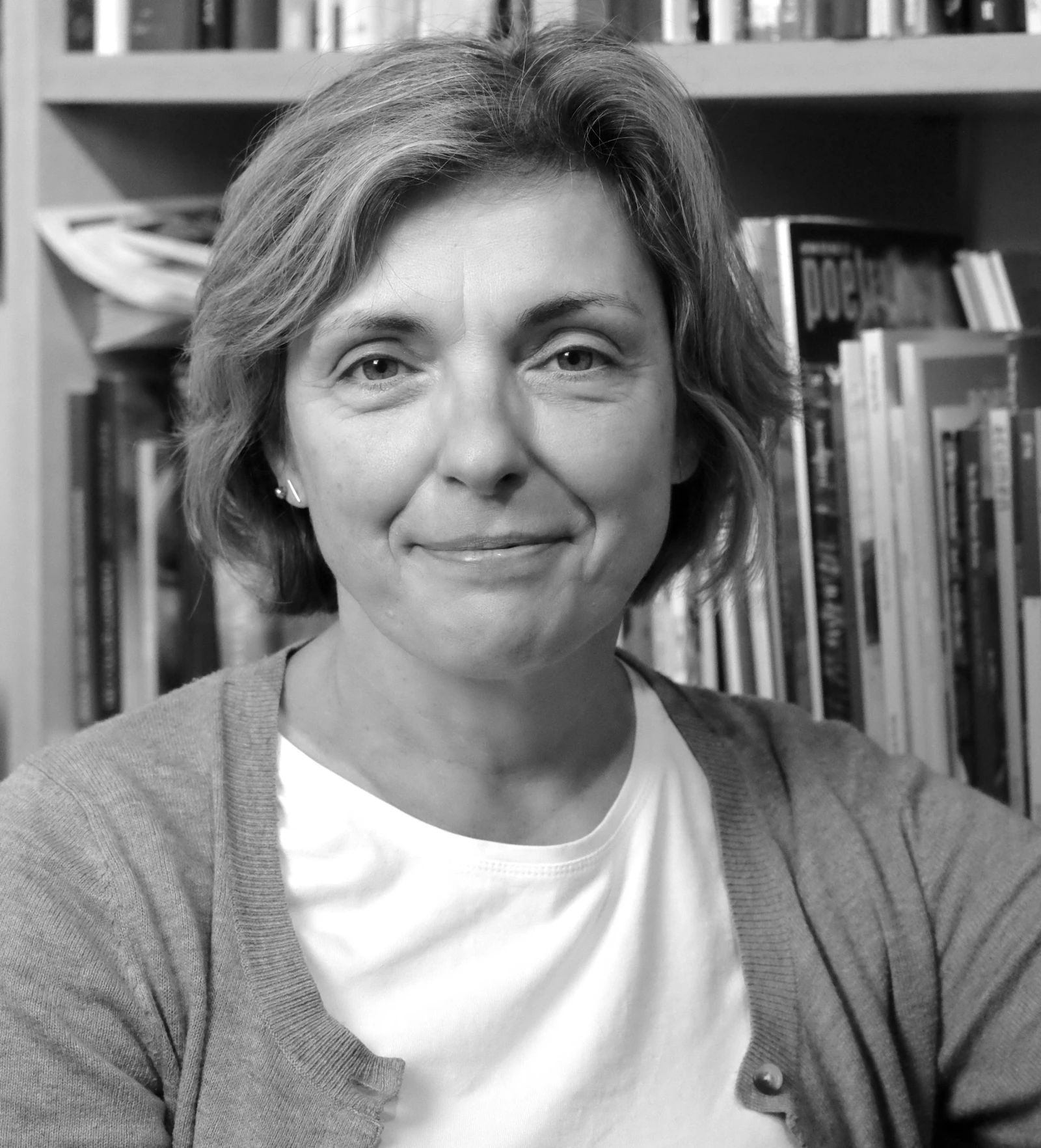
Fran Lock is a some-time itinerant dog whisperer, and the author of seven poetry collections, most recently ‘Raptures and Captures’ (Culture Matters, 2019), the last in a trilogy of works with collage artist Steev Burgess exploring the legend and lore of working class imagination, and ‘Contains Mild Peril’ (Out-Spoken Press, 2019).
Fran has recently submitted her practice-based Ph.D. at Birkbeck College, University of London, titled, ‘Impossible Telling and the Epistolary Form: Contemporary Poetry, Mourning and Trauma’. She is an associate editor at Culture Matters where she is about to launch an anthology of contemporary women's poetry with fellow editor, poet and artist Jane Burn.
Gregory McCartney: Hi Fran, welcome to the Honest Ulsterman. Can you tell me a bit about your background?
Fran Lock: Very pleased to be here. And I can certainly try, although when people ask me this question I’m never sure what is or isn’t relevant with regards to the poetry. I’m a UK citizen by birth, but I was raised with a strong sense of Irish identity and of our Traveller heritage, because that’s where my family are from, that’s the history and the culture, and it coloured everything from the food we ate to the music we listened to at home. To be honest I’ve never felt any real kinship to England as a whole. I spent my early childhood in Shetland, and then after that we were constantly on the move, so my experience of ‘home’ is quite a fragmentary thing. I’ve been too English in Ireland and too Irish for England, and generally Other to everyone. There was a weight and keenness to that in the nineteen eighties that I don’t know would be the same now, but that’s probably gone to shape how I write. Impoverished, itinerant, and not really at ease anywhere, that pretty much sums it up.
GMCC: Did you come from a literary family? Were there lots of books around when you were growing up?
FL: The short answer is probably ‘no, profoundly not’. There is very little formal education of any kind in my family background. I have some relatives, and some friends, with next to no literacy even now. But eloquent and dexterous with language nonetheless. I am passionate about books, but I’m not sure to what extent they’re responsible for my early affinity for poetry. I think that has as much to do with the verbal sleights and parries I heard at home, to do with dinner-table debates, folk songs, jokes, and just listening to the language tactics of those on the sharp end of everything. To be poor and in any way Other is to be intimately and infernally acquainted with the power of language; your daily life is a kind of continuous negotiation: for resources or essential support, or in order to avoid negative attention. Being poor, people make assumptions about the kind of person you are, how you deserve to be treated; these assumptions are embedded in and transmitted through the words they use to you, about you, and you’re really at the mercy of that. You learn to speak and to hear with such precision, I think, just to survive, in order not to be tricked or trapped or caught out or exposed, and it’s that same kind of pressured attention that’s trying to come through in the poetry I write now.
Also, I say we didn’t have a lot of books, but my mother was – and is – a single-parent powerhouse, and she absolutely instilled in me a great love of and respect for the books we did have, and for language and learning in general. Some of my earliest memories are of her reading to me, and later of us reading together; of going to the library and choosing books, which was something you could do then, there were still libraries to go to. And looking back, it wasn’t just about cultivating a passion for literature, but nurturing an ease and comfort with text and with literary spaces, a sense that yes, literature belongs to me too, that it’s something egalitarian and communal, that anyone can and should be able to access. We’re not all lucky enough to have that. And certainly, as I went through school I encountered a great deal of push-back to this idea. What are you doing here? This isn’t for you, that kind of thing.
GMCC: I read that you always wanted to be a poet? It’s a brave decision (though it shouldn’t be) for somebody from the working class to actually declare it. If I had said I wanted to be an editor or curator it wouldn’t have gone down well. The line from Sisters under the sun: ‘I do/not dream and, no, they told me, I am not a poet.’ sums it up well. Do we still expect our writers and artists to be slightly posh?
FL: I don’t know that we expect writers and artists to be posh necessarily, I just think society as a whole, and cultural elites in particular, expect working class writers and artists to be working class within very narrow, very proscribed parameters. To illustrate this point, I always tell the same story, about how when I was first sending out the manuscript for my second collection, The Mystic and the Pig Thief, a small but well-regarded indie press rejected my work on the grounds that it was ‘inauthentic’, and accused me of ‘ventriloquising’ because – and I quote – ‘working class people do not speak that way’. Wow. Imagine the breath-taking levels of arrogance and entitlement necessary to make such a statement; imagine thinking that there is only one way for working class people to write or to sound and that you know definitively what that is. Incredible. If this happened to me today I’d call bullshit, but I was far less secure in myself then, and to be dismissed like that genuinely hurt me. It made me want to give up. I think this happens to a lot of working class artists, in any field, which is absolutely what’s wrong with the representation model of inclusion: it can and has been used to create a selectively edited version of working class identity, to homogenise the vision of working class experience and culture in the arts. You end up with one or two big name ambassador-apologists who are supposed to speak for us. I think the post-war northern male is a popular one, and it feels completely deliberate, in that the poetry’s distance from the material realities it describes encodes a kind of nostalgia, a looking back that defuses potential threat (social or poetic), softens the language of experience, and makes safe what might otherwise be challenging to the cultural status-quo. It’s all about depoliticising poverty, which is something I’m anxious to avoid.
So, I don’t think of the decision to declare myself as a poet as brave exactly. I didn’t even really understand what poetry was at that age, yet alone the mechanisms by which systemic class-based erasure operates. But I do think persistence requires a certain gumption, a kind of stubbornness, and a real determination not to become bitter, or to be ground down and side-lined into the enclaves that others have deemed proper or appropriate. Slam poetry is one of these, I think. There’s this conceit that if you’re working class your poetry has to be ‘accessible’ in that very one-dimensional way, and I’m not a performance poet, I’m not a spoken word artist. I don’t think the construction of accessibility as an absolute moral category is doing poetry any favours either, I don’t understand why working class audiences can’t be trusted with poetic difficulty and the kind of sustained attention it provokes. It’s patronising, it’s a cop-out. It places the responsibility for ‘access’ on the shoulders of individual creators rather than addressing the structural inequalities inherent in the systems that administer us, the publishing cohorts, the academies, the funding bodies, etc.
Down the years I feel I’ve had to fight for my work to be seen as part of a rich, rigorous experimental practice; for my right to inhabit elite intellectual spaces. There’s a level of proof demanded of you as a working class artist that simply isn’t applied to our middle class peers, a sense of working twice as hard to be thought of as half as good. To keep going in the face of that, I actually think you need to be a bit obsessive, a little bit peculiar.
GMCC: I love ‘Contains Mild Peril’. Can you describe the process of creating it? How you decide what goes in, which poem goes where etc? I am always fascinated by how poetry collections come together.
FL: Sure. CMP is a bit different from a lot of the work I’ve been doing, in that it isn’t really ‘themed’, and in that the poems all come from different stages of my writing life. ‘Dazzler’ is from early 2014, but the ‘dead / sea’ section came together in late 2018. In terms of my practice and the sheer amount of material I’m producing, that’s one hell of a long time. I don’t consider CMP as a miscellany, though, and I’m quite anxious that it comes across like a loose assortment of odds and sods cobbled together because they didn’t really belong anywhere else, when the process of sorting and arranging felt much more deliberate and controlled than that to me. I was at least trying to choose poems that were unified by tone and texture, by the presence of what I’ve been calling ‘ambient anxiety’, that paranoid hum at the back of language, on the edge of conscious thought. I think even at their most baroque or their most tender, whatever they’re ostensibly ‘about’, the poems in CMP are also about what that anxiety does to us on the level of language, if that makes sense?
The collection took a long time to come out, so while I was refining and editing, I was also working on a variety of other, more self-contained projects, and on my doctoral thesis. As a result, I think CMP became a kind of refuge for me, a place to spend time with work – and with the thoughts and feeling initiated by that work– which are ambiguous, or seem to be beyond resolution. In that sense I wasn’t really concerned with audience, or how the book might be received, I was just pursuing something that made sense to me. Not in some kind half-baked gesture towards catharsis, which I don’t think of as being either tenable or desirable, but more to carve out a space where my anger, or my grief, or my strange lateral leaps of logic could be encountered on their own terms. There’s a certain level of scrutiny, of pressure, applied by academic research trajectories, and also attendant on putting together a collection of poetry these days; you’re expected to explain, or justify, to boil your ideas down and account for yourself and for your work. And CMP isn’t that kind of book, and I’m not that kind of person. So it’s also a species of ‘fuck you’ against the – for want of a better word – ethics of reduction and summary as well.
GMCC: The title comes from those ever-present tv warnings that are theoretically supposed to protect us but really show how afraid we’ve become of just about everything. Would it be fair to say everyone carries a sense of mild peril with them?
FL: Absolutely, and we’re living in a time, in the west at least, when the threat or the ‘peril’ we face is both all-pervasive and spectacularly diffuse. That’s what it means to be alive in a period of political instability and unprecedented environmental crisis, that’s late-stage capitalism, you know? What faces us is enormous, but it’s so bound up in the stuff, in the minutia of day-to-day existence, we’re so complicit just by being alive, that we don’t know how to meaningfully respond. Fight or flight doesn’t really make sense in this context. There isn’t an ‘enemy’, there’s just a series of endlessly reverberating self-inflicted damages. I don’t think humans are very good at dealing with that, so they panic. And then you have the kind of idiocy that’s kicking XR protesters in the head, or the other kind of idiocy that’s trying to shop its way out of climate violence. It’s all just panic, suppressed and festering panic.
So it could be that ‘mild peril’ is both our curse and our signal condition; it’s also maybe our common moral failing. By which I mean that we shouldn’t be suppressing our fear, that ‘keep calm and carry on’ is probably just about the worst advice going. I think maybe we should be afraid, deeply and viscerally afraid. I think maybe we should be reckoning with that, grappling with that. I don’t know, but there’s an impatience with ‘mild peril’ also at play, and with the idea of my own poems as merely mildly threatening, my poems – or poetry in general – becoming spaces to safely discharge anxiety, to create a kind of peaceable catharsis. I think this kind of poetry might have its place, but when we make ourselves feel better we let ourselves off the hook, and this is not really something I’m aspiring to.
GMCC: I am not your child. But I am your child. (Loneliness of the long distance runner) You seem to have a ‘complicated’ relationship with London? Is it the city it was, or maybe it’s just the city it’s always been?
FL: Yeah, but to be fair I have a complicated relationship with anywhere I’ve ever lived. Because I never belonged in or to any of those places, I never got comfortable, never developed a sense of complacency or habituation.
The thing I’ve always felt about London in particular is that you could spend your entire life occupying roughly the same spatial coordinates as other people, while inhabiting a totally different world. There are ghost architectures, ghost geographies that exist inside or under the surface of the official ones. It’s to do with how you map meaning onto space; how you inhabit and move through it. This is radically different if you’re poor, or if you’re in some way Other. Aggro is a cartographic feature: where you can and can’t go because of your ethnicity, your sexuality or your gender. Surveillance is another, and obviously money. The London-Irish squat-punk scene was a very specific cohort, with a very particular relationship to the cityscape. It’s a relationship characterised by a sense of transition; by impermanence, precarity, and by the logics of the provisional. I guess the poems are governed by those same kinds of logics, in that I look at poetry as a kind of textual equivalent to squatting: the occupation of sanctioned structures in new and inventive ways. It’s an act of repurposing, recycling, and subverting. In much the same way as a derelict office block become a makeshift gallery or a community cafe, under the shaping stress of poetry, English becomes other, takes on new forms, new life. I feel this way because English isn’t ‘home’ to me, any more than London is ‘home’. Yet here I am, here we are, stuck with it and in it, and so you have to come to an accommodation with that, to force the unhomely home to make space for you.
As to London not being what it was, I notice this in the impact of gentrification, daily. Austerity is eating some areas alive. It isn’t just deprivation, it’s that there are vanishingly few ways of circumventing the systems that inflicted this poverty on us in the first place. There’s a sense now that you can’t even have nothing on your own terms. It’s visceral here, very pressing, very real. You notice it in small things, like how you can’t even use the loose change in your pocket to get on a bus anymore; how vital information about public services is only made available on-line or via smartphone. There’s a basic assumption of affluence that erases the lived experiences of people with very little, and which refuses to acknowledge the lives of those who choose not to participate. You can’t opt out. You can’t work around. This is totally strategic. It’s about control, of movement, of data. It’s about engineering your consent by taking away any other meaningful option.
All of this scares me. Camden has suffered so much. It breaks my heart to be there now, the level of destitution is so acute. There are people who are eking out an existence in absolutely abject conditions, where once they might have had at least some options outside of the system. I don’t think it’s a coincidence that there’s one letter between affluence and effluence. We’ve seen locals forced out, the same people who made the space vibrant and creative and exciting. There are cameras everywhere now, the whole area is ludicrously securitised. Fences are going up. Lots of goons in bomber jackets with walkie-talkies. How can communities come together to resist this when there’s nowhere for real communities to form? When you’re isolated and scattered and pushed further to the margins, onto the streets? It was never this bad for us. Life was pretty hard-scrabble, but there were still spaces for us to gather and to take care of each other. I’ve cried more than once for those who have come after.
All of which is to say that obviously this shit colours how I see and how I feel about London. It holds some of my most cherished memories, but it feels increasingly like I’m walking through some kind of cartoon necropolis. I’m also aware that everything I love about the city is carried on the backs of others who have been less fortunate. I know how narrow the gap is between the people I see sleeping rough and myself. And it shouldn’t be like this. I hope I never forget that.
GMCC: ‘The North you could not claim claims you’ (The difference between) Though you live in London there are plenty of references to Ireland in the poems. Can you ever completely escape its grasp?
FL: No, probably not, but at this stage of my life I’m past the point of wanting to. It’s part of me is all. I’ll never belong there any more than I belong in England, but everything I think and do; my familial culture, my love of music, my sense of history, my idea of justice, they’re all rooted there. A lot of the poems are about that, are a tugging on the long and tangled threads of intergenerational memory.
‘The difference between’ I wrote in Belfast the morning after my best friend died. Marty had been missing a long time; he was from Belfast originally, and the last time I saw him he was supposed to be going home. I thought of him as being there, and of my being there as being close to him, even though I didn’t actually know where he was. When I took the phone call that told me he’d died in bloody Brighton, it was a desperate headfuck. Everything was backwards. That I was in Ireland and he was in England seemed totally perverse to me, yet somehow it fit: our entire lives, wherever we were, whatever we were doing at any given point, we were always on the wrong side of the sea. I knew a lot of people who felt that way, certainly within my own squat-punk cohort. We all had that sense of being mongrel, or partial, neither one thing or the other; people whose whole lives were defined by their childhoods in Ireland, by their early experiences, or by their parents’ experiences and the fall-out from that. It saturates your sense of self, it feels like it determines your whole trajectory, but you can never grasp it. You end up not knowing how to define yourself or how relate to the world. There’s pain there, the pain of irreconcilable difference, the pain of having to carry a legacy that isn’t really your own. I’ve known so many people who couldn’t make peace with that, and it just wears you out in the end.
But now I think I’m okay with it. Poetry helps with that because unlike daily discourse it accommodates some of those emotional ambiguities. Both CMP and Dogtooth traffic in this sense of being haunted, of echo and estrangement. I think the Ireland of the poems is somehow different to the Ireland that exists in real life. It’s a shadow Ireland, a phantom Ireland, existing in fragments outside of space and time. It goes with my own childhood impression of Ireland’s history: nothing ever ends, everything that happened is part of the same continually extending and repeating present. It is never not happening now, which I’ve read is also ‘trauma time’. There’s something in that, although I don’t think of the experience in entirely negative terms, there’s richness and strangeness there too.
I’m reminded of something Eleni Sikelianos says about a poem existing outside of time while being deeply embedded in it, how a poem can pivot between the temporal and the extra-temporal, can hold us in suspension outside the rational flow of time. Ireland exists in that place for me. And I don’t know to what extent that’s down to poetry alone.
GMCC: I am imagining a kind of industrial goth soundtrack thudding throughout the book. Or maybe just its echo in the morning after? And the poems have an industrial in-your-faceness lyrical anger to them: I’ll tell you what contrition is, it’s boredom/ with our past mistakes. Is this rhythm (for want of a better word) important to you?
FL: I’m glad you picked up on that, because although it’s not always necessarily by design, how I write – the characteristic cadences and overall oral texture – is heavily influenced by that whole scene. Or maybe it’s the overlap of those rhythms with something older: the exact midpoint between Combichrist and Joe Heaney. This sounds flip, but actually there is a relationship there, particularly in that restless alliterative meter I make so free with. On one level I suppose I’m always trying to pattern the sonic substance of my own lived experience, so the thumping Slimelight bass is in there, and the rhythms of Psycho-Ceilídh bands like The Dropkick Murphy’s or The Tossers or Neck. I think it has less to do with the impact on the ear than how a poem feels to be read, what it does to body and breath: some of those lines require a lot of air, or they come out in gasps, in stops and starts. On the page I’ve been told their rhythm can be tricky to grasp, but for me that’s part of the point: certain kinds of music are indistinguishable from noise to the uninitiated. You have to spend time in and with those sounds to pull pattern from chaos, and discern beauty in pattern. I want to resist a kind of easy absorption, a complacent eloquence that exacts nothing from either performer or audience. So I think I favour a slightly eccentric meter, which probably isn’t for everyone.
GMCC: I love that line in Insomnia: And grief/ is not a line we walk to wellness; the tidy smirk/ of therapy, the therapised, the girls licking flakes of gold/ leaf pastry from a Pret a Manger croissant, saying, you/ should take up yoga. It seems to a great riposte to the easy answers and inspirational messages that bombard us every day. Life is hard work you seem to say?
FL: Absolutely, but that’s not necessarily a criticism. I think life should be difficult, to a certain extent. Difficulty can be salutary, it can be the beginning of empathy. Which means the poetry that springs from life needs to be difficult too. One of the most disturbing things to me about the state of contemporary literature is that anyone can Instagram some gnomic vagaries over a picture of a sunset and we’re supposed to accept this as poetry. If you question that paradigm you’re positioned as some kind of elitist snob. I really find myself wanting to push back against this. Hard. Because I don’t believe it’s the job of poetry to translate the trauma of our raw experience into some ideal of emotional expressiveness. You can’t transform the shit that’s happened to you into a readily accessible code of plain statement, you know? And as I said before I’m not really about elevating the status of ‘accessibility’ either. Adverts are accessible, tabloid headlines are accessible, political slogans are accessible, right wing racist football chants are accessible, Fox’s dumb-fuck news-by-numbers is accessible. Why would your poetry want to ape those shitty things? Why would you want to be a torrent of smoothly scrolling data? Why would you want to reduce the reading of your work to an act of passive content imbibing? Capitalism uses ease of assimilation to slide its worst excesses past us on the sly. Those are the enemy’s tactics. Poetry needs to demand more of its readers than unconscious, uncritical absorption. It’s supposed be a place of deep, sustained attention. At its best it offers us that, makes space for us.
And it’s insulting too, isn’t it? The idea that complex emotional experiences can be boiled down and treated with a bland two-line aphorism. It’s ludicrous, and potentially very damaging. Life is hard. And there’s a violent disavowal of those who experience it as such by pretending it’s not. It’s coercive and massively suspect. Instead of offering some kind of inspiration porn placebo, get angry, organise, do something for Christ’s sake.
GMCC: ‘A fat man in an English pub is sporting his war/ like a laudable bruise.’ People used to be angry that things stayed the same but there seems to be more anger that things aren’t the way they used to be, even if the way they used to be was terrible. Is it something you’re aware of and does it influence your work?
FL: This is a very pertinent question for England right now because in many ways Brexit came about on a wave of weaponised nostalgia. I don’t know why this happens, but I suspect it has something to do with the world being in such a precarious state – environmentally, economically, politically – that people quite literally cannot imagine any kind of future. It’s impossible to be forward-looking when what you’re looking forward to is more of the same, or worse. People kid themselves that it was better in the good ol’ days. Which it wasn’t, especially for the working classes. Nostalgia is absolutely a political tool, and elites are using it to rewrite history.
In ‘Sisters under the sun’ I was thinking about that, and about the kind of militarism that’s on the rise over here, harnessed to this creepy, weirdly nationalistic script. I was writing the poem around Remembrance Sunday, and it seemed to me that instead of reflecting on the senselessness and sheer bloody waste of war the message had been subtly retuned to suggest working class lives only have value if they’re instrumentalised in the service of the military industrial complex. And that’s bullshit, absolute bullshit. All this business about calling soldiers ‘heroes’, and drawing a line of false equivalence between the people who fought fascism in Europe, and those who occupied Northern Ireland, or cluster bombed the former Yugoslavia, or followed the hand of sodding history into Iraq. It’s not that they’re bad people, that’s not my point at all, but they’re not heroes either. What makes them worthy of respect or of sympathy is that they’re human, same as all of us. And the central tragedy is that the armed forces felt like their best option, that instead of teachers or mechanics or nurses or writers or plumbers or chefs, you have generations of people whose job it is to kill other people for a living, to be shot at, to see other young people blown to bits. It’s not by accident that the armed forces typically recruit in disadvantaged areas, you know?
But there’s a virulent strain of this jingoistic toss alive and well in British society. I feel like a lot of what I do is writing back at that, in a variety of small ways: in trying to really see what’s there in front of me, a determination to face things as they were or are, historically and presently.
GMCC: You’re a fan I’ve read of Padraic Fiacc? He was in the midst of the Belfast scene but always still seemed to be an outsider. Though he appeared in the Honest Ulsterman a few times, it gave the impression back in the day that it wasn’t that keen on his work. Would you see him as a kindred spirit?
FL: I’m always slightly shy of claiming kinship, especially when the person I’m claiming kinship with is no longer around to respond. But certainly I respect Fiacc’s writing very much, for his attention to sound, for his formal inventiveness, and for his willingness, I should say compulsion, to engage with discomfort. One of my most treasured possessions is a 1977 edition of ‘Nights in the bad place’ which also features those tortured, impressionistic images by Deborah Brown. There’s a commitment in that work to the muck and pain of immediate history that’s both disturbing and admirable. Work like that is difficult to take, though, and from what I’ve read nobody ever knew what to make of Fiacc; he was a prickly fit within Ireland’s various publishing cohorts, and this has been reflected in the critical reception of his work, or rather in the lack of it. I know his legacy is beginning to be reappraised now, but for the longest time I got the impression that poetry as a whole wished he’s go away.
I think to that extent I’m similar. It’s one of life’s many little jests that what poetry as art accommodates, poetry as social scene does not. It has often been the case for me that the work which seems most urgent is the work there is no space for, because it isn’t palatable, because there’s no easily identifiable hook to hang it on, because it or you are unwieldy, and therefore unmarketable. There’s also something about being too overtly political. Not in dogmatic sense necessarily, but just your probing of sensitive political territories, and of handling that material in ways that doesn’t let anybody off the hook. It’s been my experience that people don’t like that either.
That said, I don’t especially mind being an outsider. I know I’ll never secure funding, I’ll never win a major prize, and I know that what I do won’t receive the same attention as many of my peers, but at least I get to do some version of a thing that at its best moments has sweetness and meaning to me, and at least I get to do that more or less on my own terms.
GMCC: You’re completing a PhD on contemporary poetry, mourning and trauma I believe. Is this influenced by your poetry? And how do you find changing from the academic to the poetic and back again?
FL: I actually handed my thesis in last September, but my viva isn’t until March, so I’m in this weird limbo at the moment, where I have simultaneously completed and not completed my PhD. What I have instead is akin to Schrodinger’s sodding doctorate, hovering in an indeterminate state of quantum uncertainty.
Because the thesis is practice-based, there’s a pretty even creative/critical split in my research, although the entire project was really initiated by my experience as a jobbing poet. Rather, by my inability to locate within my practice as it stood an accommodation for or expression of my own grief. When I started to probe this deficiency I realised it extended beyond my experiences as a writer, that it bled into my experiences as a reader; that it didn’t pertain to poetry alone, but stretched across multiple therapeutic trajectories to encompass all of narrative language. This was a huge thought for me. I think that both literature and therapy tend to have a kind of ‘instrumental eloquence’, that there’s a movement from point a) to point b), from devastation to consolation, and that this is what we call the work of mourning: a way of socially situating loss, assimilating it back into meaningful language. This is important work, but it wasn’t work I could perform and I didn’t initially understand why, so I became obsessed with pinning down how poetry might handle that other kind of loss, those instances of raw and recalcitrant grieving that totally unmake a person, a loss that is incommensurable with articulate language.
In that sense my critical and creative research is absolutely enmeshed, and I think in quite a healthy, symbiotic way. What I found harder to deal with was the academic research trajectory itself, which is predicated upon a highly controlled mastery over its materials, which demands a very definitive resolution within certain strictly predetermined limits. I understand why this has to be the case, but in a piece of research that treats of the unmanageability of grief, I found myself doing an awful lot of managing. My problem was less a switching between written registers, than between entire modes of being. There were days I found it challenging just being in the space of the university, challenging to constantly account for myself and my work, to be rational and communicative about something that often felt overwhelming and beyond intelligent description.
But I was really lucky, I had a really wonderful critical supervisor in the person of Dr Peter Fifield, who was able to help to me channel my discomforts and anxieties into rigorous and probing research questions, to expand my research from something very inward looking, to something evidence-based, and literature-centred. This in turn provided me with some context for my own feelings. So my finished thesis holds both these experiences of loss: grieving and mourning. Each has its own rhetoric, its own aesthetic disposition, and the completing of my research has been about recognising and allowing both to breathe.
GMCC: Do you have a daily routine for writing, set hours for example?
FL: My only ‘rule’ is that I do some writing every day. For me this could be a page of research notes, or it could be a rag-bag collection of poetic jottings. By anyone’s standards I am what has been described as ‘insultingly prolific’, but I don’t think working class life is really commensurate with a writing routine per se. That’s what I think is so wonderful about poetry, though, it is the perfect medium, the perfect method of production, for those of us mired in the wretched modern hell of unlovable labour: it doesn’t take hours of time to prepare or practice; it communicates in fragments and flashes, in moments or phrases pulled from the true. In general I am more productive in the early morning than at night. Coffee is implicated, vast, vast quantities of coffee, and long walks with my pit bull, Manny.
GMCC: I always ask both who are you reading and who would you recommend our readers investigate?
FL: Fiacc, obviously. But in general terms I’m quite wary of giving recommendations, I think because really there is no Poetry, only poetries, and what moves and provokes me might send someone else to sleep. I can only talk about who and what feeds my own head, so in order of impudence, I guess: Hannah Weiner, Sean Bonney, Jeremy Reed, Jane Burn, Rebecca Tamas, Amy Key, Abigail Parry, Vahni Capildeo, Peadar O’Donoghue, Solmaz Sharif, Golnoosh Nour, Layli Long Soldier, Patricia Smith, Chelsey Minnis, Noelle Kocot, Morgan Parker, Bobby Parker, Reuben Woolley, Sabrina Mahfouz, Luna Miguel, Drew Milne, John Clare, Harriet Mullen, Becky Varley-Winter, Emily Dickinson, Wayne Holloway-Smith, Miyo Vetsrini, and my dear mentor Roddy Lumsden. This list is by no means exhaustive, I’m literally just naming stuff that’s currently on my desk. I would also say don’t confine yourself to poetry; if you want to write well read widely, read everything, and push beyond your comfort zone.
GMCC: And finally the inevitable question: what’s next?
FL: To be honest, I have no idea. The last couple of years have left me feeling pretty shaken and defeated, so my ambitions have narrowed accordingly to: make it through the day, find moments of joy with my family and dog, and try to pursue some version of the thing I love. It isn’t that I don’t keep working, keep pushing forward, it’s just that I can’t allow that to become my focus. I have had to resign myself to the fact I will never receive the same critical attention as a number of my peers, that I will never make enough to live from my art. And if you get into that frame of mine, what else is there? Try and write better, write the things that have sweetness and meaning to me, and try to be a better person. Do good, be kind, stick to my principals. Whatever work comes out of that will at least have the merit of integrity. I just finished editing an anthology of women worker’s poerty with artist and poet Jane Burn. It was a real labour of love, and I feel lucky to have done something I believe in. So more of that, I hope.
GMCC: Thanks for being in the HU!
You can buy Contains Mild Peril at: http://www.outspokenldn.com/shop/contains-mild-peril-fran-lock

Dr. Gregory McCartney is the editor of Abridged, the HU and an independent curator.
More work by Greg McCartney


Tel: 028 7126 6946
Email: hueditor@theverbal.co
Verbal, Stable Lane and Mall Wall, Bishop Street Within, Derry/Londonderry, BT48 6PU
 company
Copyright © 2026 Honest Ulsterman