


Two More Essays

Scarred 3: Righteous Bellicosity and the Scarred.
The first story technically begat the first lie, fiction being at the very least an embellishment of something. And embellishment was probably around before fire. When humanity created narrative, when it formed fiction to create and cover its scars, it learned to live with something that existed beyond the fact. The telling of tales (and the telling of lies) is primal. We cannot stop it. We’ve been doing it since our beginnings. And of course, narrative does not depend on speech or writing. It can be performative, grunted, drawn or acted out so long as the audience recognise or are familiar with the signals in the performance. Though language assists in making for more concise and less abstract communication which was essential in the survival of the proto/pre/human creature. Fear of course is implicit in primal narratives. Fear of the unknown (hence the development of religion and mythology) and fear of the everyday can be mitigated to a degree through the creation of particular narratives. A particular and well-understood warning sign about dangerous animals/people from an individual lookout puts him/herself in danger but helps to potentially save the tribe from harm for instance. When humanity began to use narrative strategically however, fiction entered the equation, and we learned the codes to manipulate others through stories. We could then create new scenarios that allowed for our advancement and potentially the advancement of those listening to the narratives. We could narrate how we could move beyond the routine to a new better routine or protect the routine we have from the other that would seek to destroy it.
We are creatures of routine, even if we moan about that routine. We don’t like chaos in the main. Chaos is the domain of the privileged and those without empathy. When an evolution appears, and a forced one such as the Covid Pandemic at that, it leaves scars on the individual and the society that may take quite a length of time to disappear, that is, if they ever do. We operate to written codes, conscious and unconscious, self-initiated and given to us. These codes of course have been ingrained for generations and even the latest updates are based upon societal assumptions. We stop at traffic lights for example either because we care for the safety of others in our society or we are afraid of the judicial and moral consequence of driving through a green light and hitting someone walking across the road. However, when a societal trauma suddenly hits us the codes we adhere to go astray, and we resent the new paths we are forced to take. We are required to create new scenarios:
The ways that trauma affects us is consonant with how consciousness is formed in the first place. Consciousness is written as a drama in the theatre of the brain. It is written as our temperament digests our environment. Our pertinent emotional environment may be one of loving responsiveness or it may be traumatic — full of sadism, and emotional deprivation. The "play" consists of a representational world with a cast of characters who relate together by feeling, scenarios, as well as plots, set designs, and landscape. [1]
The Covid – 19 pandemic has allowed the flowering of scenarios borne of the trauma existent in society before the pandemic began as well as scenarios directly inspired by the disease – Bill Gates wants to plant micro-chips in us through vaccines, 5G phone towers are the cause of Covid – all full of often esoteric storylines peopled with well-worn racist tropes repackaged for a contemporary audience. Strangely enough at the beginning of the pandemic there was a certain amount of perhaps fairy-tale things that posited that the new world offered the opportunity for a great reset that would stress fairness and equality of opportunity:
“Across the globe,” noted Robin Wright in the New Yorker, “a coronavirus culture is emerging, spontaneously and creatively, to deal with public fear, restrictions on daily life, and the tedious isolation of quarantine.” The vision put forth by Vice itemized what needed to be done in a post-coronavirus world. “From arbitrary data caps being suspended by internet providers, to eviction bans, to suddenly-implemented protections for workers, we are seeing that things we have long been told are impossible or unfeasible are suddenly OK.” [2]
It may have shown different narratives are possible, but the reality is that the world's richest saw their wealth climb 27.5% to $10.2trn (£7.9trn) from April to July 2020, according to a report from Swiss bank UBS. [3] and the ‘let’s all pull together’ attitude seems to have dissipated, which as it was mainly a government-inspired narrative was always predictable.
We need stories though as in the end (and from the beginning) we’re a ‘species of ape, living on a rock surrounded by a deafening void, circling around a slowly dying star’ [4] We need our narratives to prove a point, often to say that things have never been so bad, so that things were much better in the good old days. Jean Baudrillard somewhat humorously takes our need for our age being exceptional to its logical conclusion:
Imagine the amazing good fortune of the generation that gets to see the end of the world. This is as marvellous as being there at the beginning. How could one not wish for that with all one’s heart? How could one not lend one’s feeble resources to bringing it about?
The end of the world is of course the ultimate bad news event. We know that it will and simultaneously won’t happen. The world will be burned to a cinder when the sun expands on its road to death in about seven billion years or so. We also know that the world won’t end as the timescale is too immense and far away to trouble us. Humanity might, through global warming or nuclear catastrophe or even through a fatal pandemic but the Earth will continue (for seven billion years at least), indifferent to our fate and probably all the better for our demise till its swallowed up by our expanding sun. We struggle to imagine the end of things though, so we create stories and call them ‘post-apocalyptic’. This isn’t new of course. Early Christians obsessed over when exactly the end of the world would occur (and Christ would return) and in the last few centuries ‘Dispensationalist’ theology has taken hold in American evangelistic circles. Originating in England the concept of Dispensationalism posits that there are different epochs or dispensations in history and that eventually there will be a ‘Rapture’ that takes the believers into heaven, leaving the rest of us behind to face a period of ‘tribulation’ (usually a millennium of 1000 years – hence ‘premillennial dispensationalism’) of chaos and turmoil which ends with the second coming of Christ and the establishment of his new kingdom on earth. This mixture of religious fundamentalism (it’s only the believers of a particular hue that will survive) and the post-apocalyptic has had a tremendous influence in the contemporary western world and in America in particular. Fervent believers are forever on the lookout for ‘signs’ that we’re in the ‘end times’ and the American political right has taken advantage of this search for a particular narrative:
Premillennialists made much of the current problems of society and interpreted them as "signs of the times." Political corruption, pornography, alcohol abuse, the rise of monopolies, labour unrest, the desecration of the Lord's Day by immigrants, worldliness in the church, liberal theology, international conflicts, forest fires, earthquakes, revivals, the rise of cults like Christian Science and Millennial Dawnism (Jehovah's Witnesses), polio and influenza epidemics, changing weather patterns, the rise of Zionism, the sinking of the Titanic, the partitioning of Europe after World War I, radio—these and countless other events and trends were seen as proof that premillennialism was correct and the end of the age was rapidly approaching .[5]
President Trump’s decision to move the US Embassy in Israel to Jerusalem was considered as an offering to his US Evangelical Constituency (Jerusalem plays a central part of the ‘end-of-days’ concept) rather than for any practical reasons. Indeed, outside of Israel itself, it was generally considered to be a catalyst for instability and even violence.
Post-apocalyptic fiction shares some aspects with end-times philosophies. Usually in such fiction because of greed, disease, over-production of natural resources or war most of humanity has been wiped out and those that remain battle each other to survive. In the Rapture, believers are taken up to heaven and the earth left to the evil and faithless. There is usually in both a morality, if from very different perspective’s that stresses that because we did or didn’t do this or did or didn’t believe in this humanity has brought on the apocalypse itself. Both end times philosophy and many post-apocalyptic novels and films/tv series seek the wish of a new, better, more moral society, whether it’s Christ’s Kingdom or a new cooperative way of living. The struggle ‘to be good’ or ‘to believe’ imbue both end-times belief and much post-apocalyptic writing.
In Cormac McCarthy’s The Road for instance, David Roman notices that the wish that any new society that emerges from the ashes of the blight that destroyed it is a more ethical, civilised, moral one:
One goal…in The Road is to ensure that the next civilization to emerge from the ruins of the blight is not built by those who have survived by savagery; the son is staying good also for practical reasons, so he can carry that particular bright torch into the future. McCarthy appears to embrace this response: at the end of The Road, the weakened father dies, but the son, right away, comes across a family that is obviously made up of “good guys,” and the encounter looks very much like that cherished start for a new, ethical civilization. [6]
Of course, as Roman rightly points out the attempt to be good guys is often doomed from the start as the protagonists have to adapt to their situation. He gives the example of the numerous attempts of the characters in the Walking Dead television series to stay ‘on the right path’ and failing both at attempts of creating a nostalgic normalcy in a zombie filled world and adhering to a likewise nostalgic concept of morality based on pre-apocalyptic norms. [7]
Likewise, in the computer game, The Last of Us, parts I and II, we see the attempt to live properly and act out of compassion in the initial game reap fatal consequences and a loop of violence/revenge in which all protagonists in the second are caught up in and suffer. Thoughtless love has consequences seems to be the theme. The killing of a character that isn’t even named in the original game leads to the violence and hate that imbues the sequel. Joel in saving Ellie (the main protagonists in The Last of Us) from being operated on and being made the basis of a vaccine that would save humanity from a mutated Cordyceps virus, made a decision that wasn’t his to make. That decision would initiate the cycle of violence that permeates the Last of Us Part II and destroy the attempts at domesticity and living by a moral code that the characters attempt. Ellie, in the second game attempts to settle down with her partner and baby but is so crushed by the violence and post-traumatic stress that she flees her home in search of revenge. The sins of the father-figure (Joel) were visited upon Ellie and upon Abigail, the daughter of the nameless doctor that Joel killed in the process of taking Ellie from the operating theatre. It is almost biblical and it’s no coincident that Ellie and Joel sing Poor Wayfaring Stranger, a song that has origins in the Nineteenth Century evangelical era in the US:
I know dark clouds will gather 'round me
I know my way is hard and steep
But beauteous fields arise before me
Where God's redeemed, their vigils keep.
The difference of course between the Last of Us characters is that any redemption for them is flawed and time-limited at best. Not for them is the certainty of the fundamentalist Rapturists. Rather it is the journey through adversity that makes them, even if it ends up in failure and fatality and makes them the better for that.
Both the Rapture et al and The Last of Us say much about our fascination with the end of things and seeing how people suffer and positing how people react in that suffering. Freud puts it quite concisely:
The fateful question for the human species seems to me to be whether and to what extent their cultural development will succeed in mastering the disturbance of their communal life by the human instinct of aggression and self-destruction.
The Last of Us and similar post-apocalyptic fiction are often exercises in creating shades of grey in terms of placing their characters in situations in which they have to act in morally dubious ways whether in self-defence or to ensure everyday survival. As has been pointed out:
From the early post- Hiroshima films of the '40s which anticipated global atomic conflict and the cautionary tales of short and long-term effects in the '50s through to the hero myths of apocalypse in the '80s, a discernible shift away from an imagination of disaster toward one of survival is evident. These films, and in particular those of category 4 (see Figure 1), have drawn upon pre-existing mythologies of cataclysm and survival in their renderings of post-holocaust life. The most potent of these myths is the recasting of the Judeo-Christian messianic hero who battles an antichrist and his followers, liberating an oppressed community and thereby enabling social rebirth. [8]
Rapture theories were/are of course all about survival and the terror of dissolution added to theories of control (only the elect survive) and lots of judgement and smiting from an outraged deity. Susan Sontag wasn’t always on the ball when it comes to her opinion of Science Fiction and her opinion of ‘fantasy’ fiction of as normalising the horrors of contemporary existence isn’t great either:
Ours an age of extremity. For we live under continual threat of two equally fearful, but seemingly opposed, destinies: unremitting banality and inconceivable terror. It is fantasy, served out in large rations by the popular arts, which allows most people to cope with these twin spectres. For one job that fantasy can do is to lift us out of the unbearably humdrum and to distract us from terrors, real or anticipated-by an escape into exotic dangerous situations which have last-minute happy endings. But another one of the things that fantasy can do is to normalize what is psychologically unbearable, thereby inuring us to it. In the one case, fantasy beautifies the world. In the other, it neutralizes it. [9]
To be fair she was writing in the 1960s though many SF films are still fairly formulaic today. In fact, that spin-off from SF films, the contemporary ‘superhero’ film is depressingly predictable for the most part, even if it does claim to be feminist or anti-racist. The good guys/gals still wear white (so to speak) and are beautiful and the villains are always ‘freaks’ of some kind, mutated emotionally or physically:
This is the undeniable pleasure we derive from looking at freaks, at beings excluded from the category of the human. The sense of superiority over the freak conjoined in varying proportions with the titillation of fear and aversion makes it possible for moral scruples to be lifted, for cruelty to be enjoyed. The same thing happens in science fiction films. In the figure of the monster from outer space, the freakish, the ugly, and the predatory all converge-and provide a fantasy target for righteous bellicosity to discharge itself, and for the aesthetic enjoyment of suffering and disaster. [10]
Righteous Bellicosity is a great description of not only Rapturist philosophy but traditional US foreign policy. It’s no coincidence that many of the classic US Sci-Fi films are essays in Cold-War paranoia, the 1956 Invasion of The Body Snatchers being a prime example. Sontag claimed there were no social criticism in these types of film. However, this is to miss the point as these pictures are in themselves fables of the world as it was then, especially politically and socially. We see Church and State fail. As we can see from the undermining of ‘experts’ in the recent Brexit debate and the scepticism in the US in regard to vaccines the suspicion of scientists prevalent in mid-century Sci-Fil films hasn’t disappeared:
Disinterested intellectual curiosity rarely appears in any form other than caricature, as a maniacal dementia that cuts one off from normal human relations. But this suspicion is usually directed at the scientist rather than his work. The creative scientist may become a martyr to his own discovery, through an accident or by pushing things too far. The implication remains that other men, less imaginative-in short, technicians-would administer the same scientific discovery better and more safely. The most ingrained contemporary mistrust of the intellect is visited, in these movies, upon the scientist-as-intellectual. [11]
This written sixty years ago still resonates today. We need rationales for our scars, and we can’t blame ourselves.
Dystopian fiction and films often see the individual make a stand against a massive corporation/government/judiciary entity. This appeals to all shades of political opinion. From those who fear capitalism to those that are convinced ‘big government’ are coming to get them:
In The Hunger Games, a series of books by Suzanne Collins and made into three films, the lead character, Katniss, honing her battle skills in the wooded wilderness is claimed by both sides of the US political divide, as something of a icon battling big government, or as a feminist hero battling authoritarian hegemony. The Hunger Games crosses the American divide earning plaudits with liberals as well as some of the Tea Party hardcore.
As Ellie in the Last of Us says: ‘Endure and Survive’. Do whatever you need to get through. At its most admirable a stoicism that deflects whatever the world throws at us, at its most annoying in the never-ending stream of inspirational messages and at its most dangerous in the lunacy of QAnon. The same darkness that haunted our Stone Age ancestors still haunts us and we need the same embellishment to convince ourselves we’re safe from the things that exist within it.
Scarred 4: Dial X for Ruin Porn
In the late 1990s, when the internet appeared, and I finally got over my terror of using it there was a couple of great websites to which I became a regular visitor. One was Gothic Gardening and the other was Abandoned America, if I remember its name correctly. It certainly was about abandoned America or a certain aesthetic of US abandonment. The gothic gardening is for another essay but the second became instrumental in the creation of the Abridged aesthetic. Abandoned America (which we’ll call it for ease’s sake) beautifully catalogued abandoned and forgotten towns on the edge of deserts in the USA. The images struck me as poetic and melancholy. Contemporary ruin was in the main not something that contemporary art explored, apart from photographers documenting the sad demise of Detroit, which did not always go down particularly well with the city’s inhabitants. Of course, there was extensive photographic projects that documented the collapse of the industrial base of Northern England but whilst perhaps featuring closed factories and coal mines the focus was very much on people. ‘It’s grim up North’ so to speak. The scar was very much on the people and on the land. The closed factories a blight and a sure sign of urban decay. At home, sets of works articulating bombed out premises and the consequences of the Troubles, the scars so to speak, appeared now and again in local galleries.
I’ve always been somewhat conflicted about these images which didn’t stop me initiating Abridged 0 – 7: Abandoned Donegal in 2006/07 with it finally appearing in exhibition format in 2010. It featured photographs by photographer Denzil Browne and essays by Declan Sheehan and Maria Finch. The curatorial remit was essentially to find and photograph modern ‘abandoned’ commercial premises in Donegal. The only stricture (and a pretty impossible one I’ve since realised) was that I didn’t want any ‘poetic’ shots. Turns out that nearly any shot of structural abandonment has a poetry to it, even the most heavily documentary orientated. You can’t de-aestheticize the image or the viewer for that matter. Why commercial premises rather than homes in this instance? Commercial activity in a sense is always a risk. It may fail because of the economic circumstance, changes in society, governmental policy or just bad luck. It isn’t necessarily a reflection on those that owned and/or worked there though of course it isn’t possible to disassociate premises from their workers. However, they were/are definitely part of the fabric of a place. Local shops ‘or independent traders’ as they’re referenced now and pubs were integral to a location. Even local factories are looked back with a certain fondness on occasion. We still talk about the factory buildings in Derry and the formidable women that worked within even though they have all been converted into art galleries, community hubs and flats or knocked down. We generally don’t talk about the terrible wages that might have been the lot of those that worked there.
I wanted to create an ‘Abandonment Archive’ that the community and present and future researchers could use to articulate the life of a particular place. It was never simply about ‘ruin porn’ as it’s called. Ruin porn is a somewhat lazy moniker anyway, categorizing every work on modern ‘ruins’ as exploitative. Richard B. Woodward put it beautifully:
Ruin Porn is a phrase so immature and gawky it isn’t sure how seriously to take itself. Like its linguistic relatives “animal porn,” “shoe porn,” “food porn,” “real estate porn,” and “fill-in-the-blank porn,” it’s a smirking neologism that may or may not aspire to be a social critique. [12]
I’m not sure how a photographic essay on derelict New York subways is exploitative for instance. It’s true, an army of artists photographed every part of Detroit in particular helping to create a rather simplistic narrative that decontextualised (if noticed at all) the people that actually lived there and photographed only the most run-down and photogenic parts of the city. Thus
instead of providing a neutral viewpoint of a structure with a complex history, the photographer artificially heightens certain properties of a ruin in order to exploit one small aspect of its history. Institutional abandonments such as hospitals and asylums are particularly vulnerable to this cheap sort of exploitation. [13]
These photographs are a type of theatre and as most theatre is fiction, they similarly tell a story that is either partial at best or not true at all. Porn, suggesting exploitation for money is a bit harsh though. Sentimentality/Romanticism is probably the most they are guilty of or a continuation of the picturesque with ambitions of the sublime. Most of us see a hundred potential vistas that could symbolise apocalyptic urban decay on our trip to do the shopping, most of us fortunately ignore them, or at least we used to before the advent of mobile phones and social media. It takes great skill to make the contemporary post-industrial landscape interesting, in particular relation to abandonment. Locky Morris, the Derry based artist does it brilliantly (and very humorously) in his Instagram works featuring many small lost things he discovers on his walks around. Worth checking out.
The fictive elements in these pictures are entirely keeping with art history of course. Through the centuries ruins and indeed idealised landscapes have been recontextualised on canvas, particular meanings or aspects emphasised. It could be said that these images of contemporary abandonment are a type of if not magic realism, then fantastic realism. Fictive descriptions of buildings and neighbourhoods tended to be the prerogative of estate agents and real estate developers, ‘gritty’ being the most notorious description of a rundown or dangerous neighbourhood. Edgy was another term designed to attract the hipsters. The most interesting ‘ruin’ photography has a cognisance of the context in which the building operated and is situated in. It’s all about the people, community, economics, society.
I do love photos of industrial/architectural decay, or rather I did, and I still do if the photographer adds something to the conversation or if it’s the important documentation of a particular building that will be lost to posterity otherwise. I am admittedly a little tired of seeing just ruins as though they still look great there isn’t much else to them. If at least the photographer includes some details about the inhabitants/workers/users there is at least a depth and a documentary deeper than just the aesthetic.
My interest has somewhat switched to the depiction of ruins within the computer game environment. As has been pointed out:
Games have consistently embraced the post-apocalyptic setting. It invites excitement, apprehension and a deep curiosity, and plays on the thought-provoking hypothetical, the 'what if?'. And when these post-apocalyptic environments and landscapes are incredibly detailed, they can result in great efficacy and power. [14]
Storytelling within an apocalyptic space strikes me these days as more interesting tha a straight depiction of contemporary ruins. It’s an exercise in what-ifness, reality once removed, an imagined future instead of a somewhat romanticised depicted of the past. We discussed the apocalyptic in relation to the Last of Us in the above essay and it’s also possible to discuss the game in relation to apocalyptic landscapes. The game realistically depicts the ruins of Boston, Pittsburgh and other eastern U.S. locales after the world has been plunged into chaos by a mutation of a cordyceps virus and with nature beginning to reclaim the suburban and city environment. We see the cities in all seasons, beautiful in spring, summer and autumn and cold and frozen in winter populated by infected people and brutal gangs of survivors:
"Usually, what you see with survival games is that they're very bleak and serious or they're only about the monsters and the science behind everything," said creative director Neil Druckmann. "Yes, we based the story on something that's grounded in reality, but it's not even about that. It's really about the interesting contrasts that exist within this world." (Ibid)
The developers made very effective (and subtle) use of the detritus of an utterly changed world. The player finds notes between lovers, parents and children and siblings detailing their journey throughout a crumbling world:
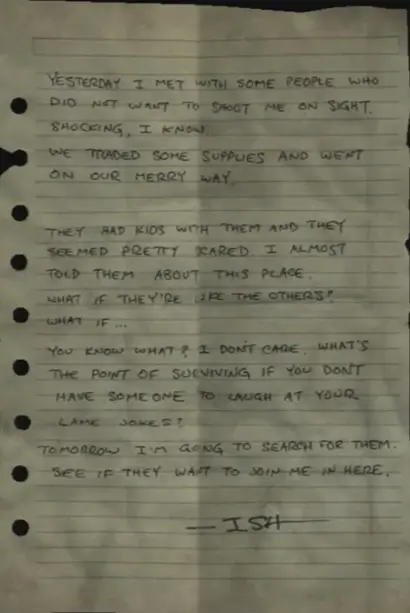
This world as is more than just a background scene. Rather it becomes an emotional experience and a narrative as it were from the people in the game. You can ignore all these notes and signs of humanity of course and the game become just a shoot-em-up, if still a very good one with great central characters. However, if you do you overlook the fact that landscapes are nothing without humanity. In fact, the concept of the landscape is a human conceit. Without the spectator to ‘frame’ what is seen the concept of a landscape can’t exist. It is just earth, sky etc. Framing the landscape went hand-in-hand with owning it, fencing it, farming it, and often crucially keeping others out. Landscape painting as a genre (as opposed to being somewhat incidental or used as symbolism in religious paintings) began in the 1600s in Europe, notably with the prosperous Dutch. The sites represented in European landscapes were generally historical, agricultural or urban settings and their representations often expressed a reinforcement of particular concepts of social hierarchy and the emphasis/reemphasis of certain religious/moral standards. This was a time of social/religious turmoil in Europe and it was a good idea to reinforce your perspectives particularly if you were wealthy and powerful.
There’s always an attempt at articulating hubris of course and this led to the concept of the sublime, developed by Edmund Burke in A Philosophical Enquiry into the Origin of our Ideas of the Sublime and Beautiful published in 1757. Burke defined the sublime as an artistic effect productive of the strongest emotion the mind is capable of feeling. He wrote ‘whatever is in any sort terrible or is conversant about terrible objects or operates in a manner analogous of terror, is a source of the sublime’. ‘Analogous to terror’ in other words at a safe distance. A visit to the slums of London would have been more terrifying to many who explored the sublime of Swiss mountains though not nearly as picturesque. This sense of the sublime and it’s slightly prettier sibling the picturesque is an implicit part of much contemporary ruin photography.
In the Last of Us we see the contemporary indicators of wealth and power, the massive office blocks invaded by Nature, their walls and windows broken, their furniture rotting away. However, the emotion they bring from the viewer is not of the sublime but instead of the mundane, the everyday and even the boring:
In one abandoned town depicted in "Last of Us," there's a record store. Inside, there are rows of albums with covers based on real-world records that were all created from scratch by the game's artists. It's not a place that's vital to the main storyline. There's not even a motivating reason for players to go inside. They could walk right by it. It's just there. It exists.
"The direction many times for the artists was to not be afraid of being mundane," said game director Bruce Straley. "As creators, we all want to show off. The biggest challenge for this game aesthetically was grounding things and keeping them simple. Sometimes a post office is just a post office. If every roof is caved in, then no roofs are caved in." [15]
The future of contemporary ‘ruins’ will be interesting. We saw perhaps a glimpse of it when many artists photographed Irish ‘ghost estates’, i.e. half-built housing estates, after the crash in 2008, left to the elements when the resources to complete them had run dry. The Covid pandemic has scarred our city cities with many of the leading brands closing or being sold to online businesses that have no need for a physical selling place or indeed for staff. We all see offices abandoned in favour of the spare bedroom or the sofa office. It won’t be long before office managers become a thing of the past as corporations realise they don’t need actual offices beyond the occasional hiring of a space. Then they will quickly figure that working from home can be done anywhere in the world and people elsewhere can be paid much less. Maybe office complexes will be the new ruins. Abridged 0 – 7: Abandoned Donegal featured a very modern but empty Fruit of the Loom factory. Will we return to the ‘ghost towns’ of the 1970s and 1980s populated with former shop workers, the victims of the move to online shopping and the debris from the ‘professional’ sector, left behind as their employers relocate to cheaper climes? It’s hard to say but there’s no doubt there will be empty office blocks and perhaps more desolate high streets and there will always be people to photograph these. Ruins are implicitly all about people of course but ruined people aren’t romantic at all and we only tend to see what they’ve left behind. Computer games are expanding how we explore humanity in fictional landscapes so hopefully artists will likewise keep people to the fore in any articulation of future architectural/social decay.
Much appreciation goes to the Arts Council of Northern Ireland who made these essays possible through their Artists Emergency Programme.
[1] https://www.psychologytoday.com/gb/blog/the-theater-the-brain/201509/trauma-outpaces-our-ability-adapt
[2] Binoy Kampmark, Journal of Global Faultlines, June-August 2020, Vol. 7, No. 1 (June-August 2020), p59.
[3] https://www.bbc.co.uk/news/business-54446285
[4] Post Memes, Eds: Alfie Bown, Dan Bristow. Apocalypse Memes for the Anthropocene God: Mediating Crisis and the Memetic Body Politic, Bogna M. Konior, Punctum Books. P45, (2019).
[5] https://www.christianitytoday.com/history/issues/issue-61/dispensational-premillennialism-dispensationalist-era.html
[6] https://lareviewofbooks.org/article/the-ethical-game-morality-in-postapocalyptic-fictions-from-cormac-mccarthy-to-video-games/
[7] Ibid
[8] Surviving Armageddon: Beyond the Imagination of Disaster, Mick Broderick, Science Fiction Studies , Nov., 1993, Vol. 20, No. 3 (Nov., 1993), pp. 362-382.
[9] https://americanfuturesiup.files.wordpress.com/2013/01/sontag-the-imagination-of-disaster.pdf
[10] Ibid
[11] Ibid
[12] https://www.artnews.com/art-news/news/the-debate-over-ruin-porn-2170/
[13] >https://www.huffpost.com/entry/on-ruin-porn_b_816593?guccounter=1&guce_referrer=aHR0cHM6Ly93d3cuZ29vZ2xlLmNvbS8&guce_referrer_
>sig=AQAAAFHEb1LwTnbNLFOytx1mXLKOM_ikRAQqpVZ8fTaEEwa7p4Sk2ijfYaZfAOiaabA-_CxAOAya4QVSX5sKAnfj5c-
>v9eWmF5dEfYoLBDaOsgsWQ_2hzxNm3gg_3Jkuwx772GTadbNq7h3XRsfxekHNUvtk6aJUQFwGvUTcKEnxi0sw
[14] https://www.eurogamer.net/articles/2018-11-12-the-post-apocalyptic-landscapes-of-video-games

Dr. Gregory McCartney is the editor of Abridged, the HU and an independent curator.
More work by Greg McCartney



Tel: 028 7126 6946
Email: hueditor@theverbal.co
Verbal, Stable Lane and Mall Wall, Bishop Street Within, Derry/Londonderry, BT48 6PU
 company
Copyright © 2026 Honest Ulsterman